Enter your own 13 playing cards and find a legal way to group them. This free Indian Rummy hand solver looks for pure sequences, impure sequences and sets, then reports whether the hand meets the common two-sequence declaration requirement. It is a learning tool, not a real-money gaming service.
Explore more free exercises in Games & Learning Tools.
Interactive Indian Rummy Hand Solver
Choose exactly 13 cards. Tap a card to remove it. This tool models one 52-card deck plus up to two printed Jokers. Wild-rank cards are treated as substitutes in this simplified solver.
How to use the Rummy Hand Solver
- Choose the rank and suit of a card, then select Add card.
- Repeat until you have entered exactly 13 cards. Tap any displayed card to remove it.
- Add a printed Joker if your hand contains one; optionally choose a wild Joker rank.
- Select Solve my hand to see one best grouping, unmatched cards and a declaration check.
- If your hand is not fully valid, review the unmatched cards and practise alternative combinations.
What does the solver check?
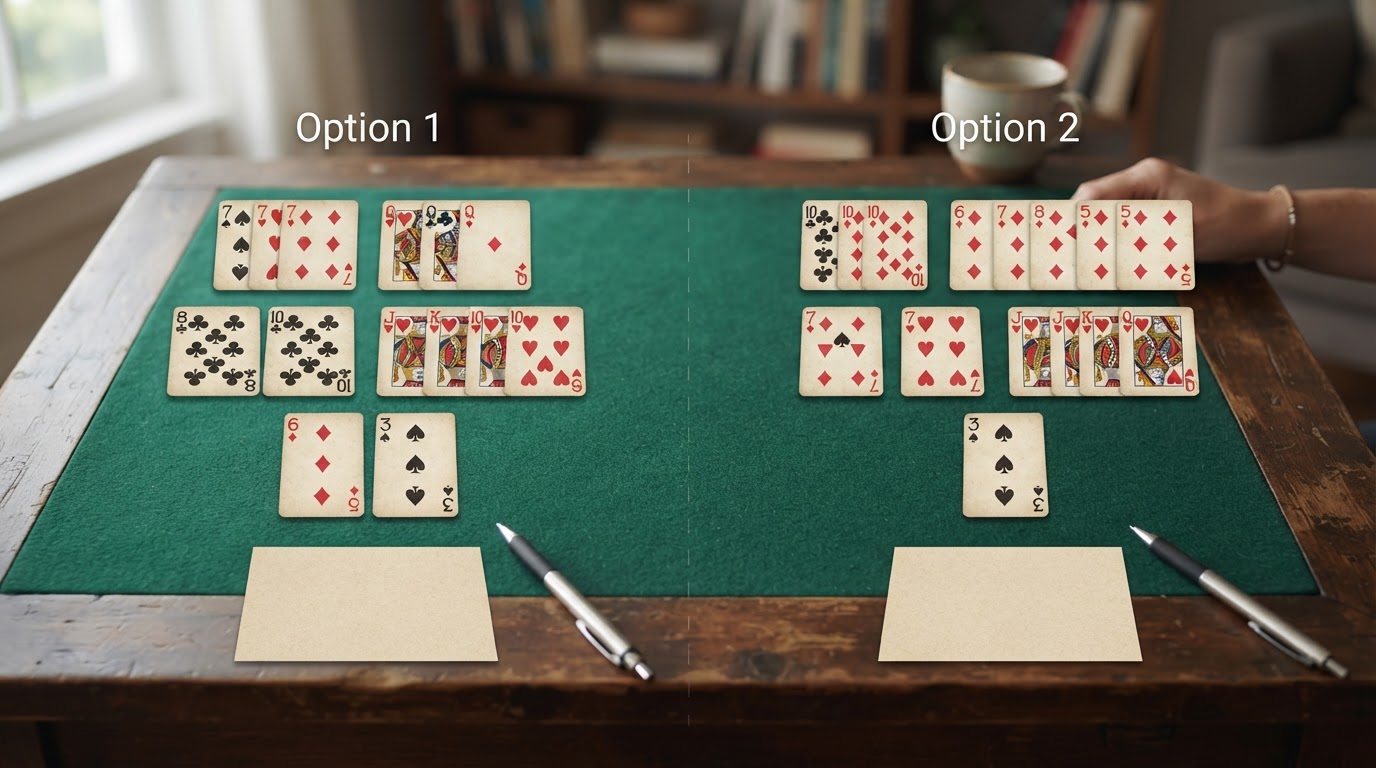
A pure sequence has at least three consecutive natural cards of one suit. An impure sequence uses a Joker as a substitute. A set contains three or four equal-rank cards in different suits. Under common 13-card Indian Rummy rules, a declaration needs at least two sequences, including at least one pure sequence, with all 13 cards in valid groups.
Example: a valid 13-card hand
4♥ 5♥ 6♥, 9♣ 10♣ J♣, 2♦ 3♦ 4♦ and 7♠ 7♥ 7♦ 7♣ form three pure sequences and one four-card set. The groups account for all 13 cards. Select Load example to test this arrangement.
How is this different from a Rummy practice game?
Our 13-card practice game asks you to find and form groups yourself. This solver instead analyses cards that you enter. It can identify a grouping, but it cannot predict which card will be drawn next or guarantee the best move in a live match.
Important rules and limitations
The current solver models a single 52-card deck with up to two printed Jokers. Wild-rank cards are treated as substitutes, rather than also being tested in their natural positions. It shows one best grouping under this simplified model, not every possible declaration or platform-specific rule. Some Indian Rummy games use two decks or different Joker conventions. Always check the rules of the game you are learning.
Frequently asked questions
Can the solver tell me if I can declare?
It checks whether the entered hand can be grouped into valid combinations under its simplified rules, including the two-sequence and pure-sequence requirements.
Does the solver support Jokers?
Yes, printed Jokers and a selected wild Joker rank are supported as substitutes. Wild-rank cards used naturally are not fully modelled in this version.
Is the solver free?
Yes. It runs in your browser without an account, payment or deposit.
What should I do with unmatched cards?
Unmatched cards show which cards the solver could not include in its chosen grouping. They are not necessarily the best cards to discard. Try the Declaration Detective quiz to learn more about valid declarations.
More Rummy tools
Use our Rummy Points Calculator to calculate the face-value total of unmatched cards, or visit the learning tools hub.