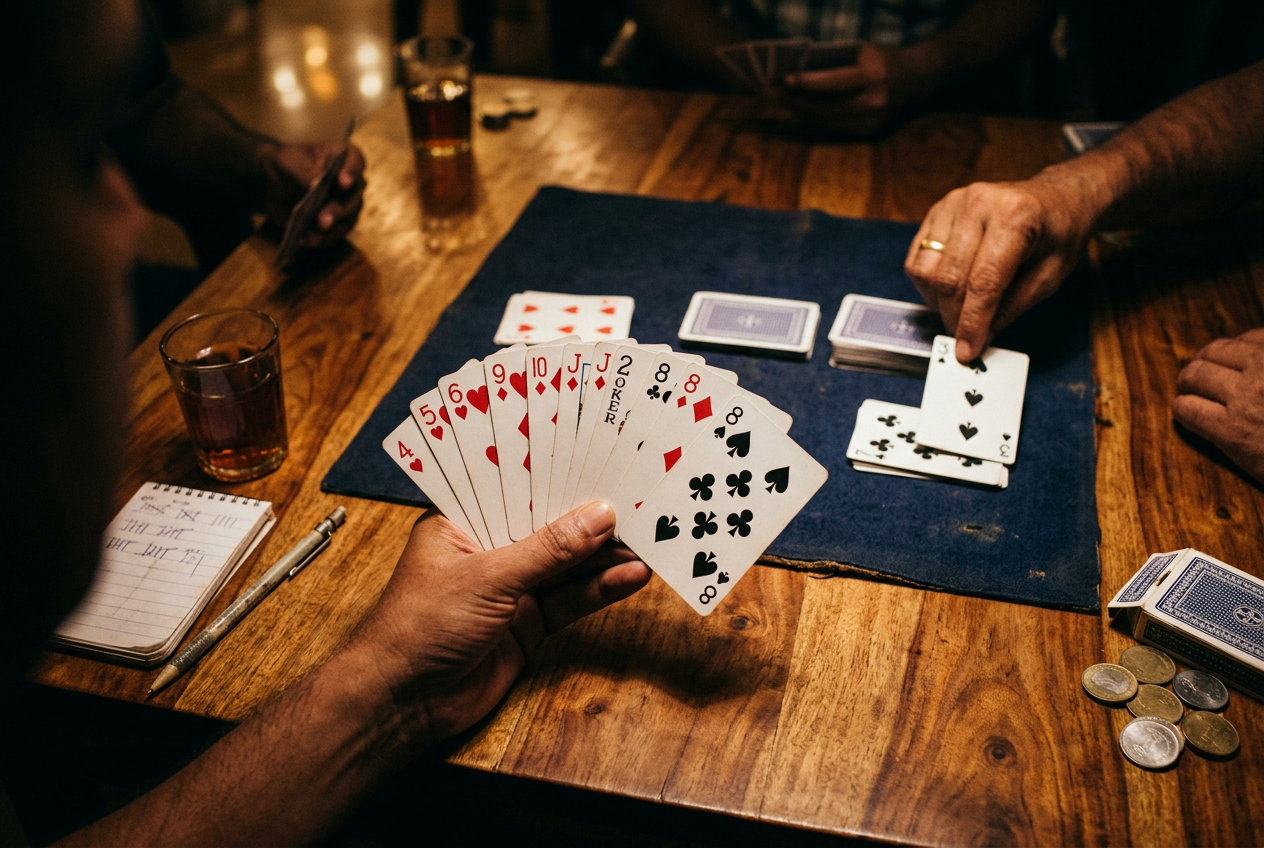
Most players treat 13-Card Indian Rummy like a solitary puzzle. They stare at their own 13 cards, pray for the right Joker, and treat the rest of the table as background noise.
That is exactly why they lose to seasoned sharks.
At a high level, Indian Rummy is not a game of card sorting—it is a game of asymmetric information warfare. Every card you pick from the open pile is a public confession, and every card you discard is a broadcast signal to five hungry minds. When you stop playing your cards and start playing your opponents’ assumptions, you unlock a completely different game.

1. The “Silent Pick” Rule: Why the Open Deck Is a Trap
Beginners love picking from the Open Discard Pile because it offers instant gratification. Need a 7♠? There it is, sitting face-up.
Pro players treat the Open Pile like a radioactive zone.
- The Information Leak: The moment you pick 7♠ from the open pile, every observant player at the table instantly deduces two possibilities: either you hold 5♠ – 6♠, 6♠ – 8♠, or two other 7s. Within three seconds, your opponents mentally quarantine every 6♠, 8♠, 7♥, and 7♦ in their hands.
- The Pro Counter-Move: If you are early in the game and need a middle card, draw from the Closed Deck even if a decent connector sits face-up—unless that single card completes your Pure Sequence or lets you declare immediately. Starving the table of information is worth far more than saving one turn.
2. Weaponizing “False Tells” (The Art of Lying With Discards)
In poker, players bluff with chip bets. In Indian Rummy, you bluff with discard symmetry. Because human brains are wired to look for patterns, you can intentionally feed false patterns to manipulate what your opponents throw away next.
The “Phantom Set” Bluff
Suppose you are desperately waiting for Q♦ to finish 10♦ – J♦ – Q♦, and you happen to draw a useless Q♣.
- What beginners do: Hold the Q♣ hoping for another Queen, or discard it randomly.
- The Psychological Play: Discard the Q♣ decisively. To the rest of the table, throwing away a high-value Queen signals: “I have zero interest in Queens.” Two turns later, the player to your left—who was nervously holding onto Q♦—will happily discard it right into your lap, thinking it is completely safe.
The “Suit Abandonment” Illusion
If you hold 4♥ – 5♥ – 6♥ (already complete) alongside a stray 9♥, discarding the 9♥ early convinces opponents that you have abandoned Hearts entirely. They will then treat Hearts as a “safe dump suit,” unknowingly feeding you extra Heart connectors if your hand shifts later.
3. Reverse-Engineering the “Panic Discard”
Have you ever noticed how a player suddenly throws away an Ace or a King on Turn 6 after holding it all game? That is rarely a strategic move—it is a Panic Discard, and it tells you everything about the state of the table.
When an opponent suddenly dumps high-value deadwood mid-game, it means one of two things:
- They just completed their Pure Sequence: Up until this turn, they were clinging to high cards hoping to form a set, or they were too distracted building a run to clean their hand. Now their safety net is locked, and they are shedding weight for a sprint finish.
- They are 1 or 2 cards away from declaring: Players holding a bloated hand hold onto high cards out of confusion. Players who dump a 10-point card on Turn 6 or 7 are usually clearing their final ungrouped card before declaring.
Your Tactical Response: The instant you spot a mid-game Panic Discard from a tight player, stop chasing greedy 4-card sets. Switch immediately to damage-control mode—dump your own ungrouped face cards before the hammer drops.
4. The “Fishing” Technique: Baiting the Open Pile
Sometimes, you hold two cards that look like a sequence—say, 8♣ and 9♣—and you want to know if anyone else is hoarding 7♣ or 10♣.
You can “fish” for information by discarding a card of the same rank from an adjacent suit, such as 8♠ or 10♦.
- If the player to your right snatches your 10♦ immediately, they are building a Set of 10s—meaning they are likely holding 10♣ hostage in their hand.
- Knowing that 10♣ is locked in an opponent’s set saves you from wasting five turns waiting for a card that will never come, allowing you to pivot your 8♣ – 9♣ in another direction immediately.
5. Cognitive Overload: Why Speed Kills Accuracy
In digital and fast-paced table Rummy, most 80-point invalid declarations don’t happen from lack of rule knowledge—they happen from working memory overload.
When a player holds 13 cards, tracks 5 opponents’ picks, calculates Joker substitutions, and watches a ticking 30-second shot clock, their brain takes shortcuts. This is why pros keep their physical or digital hand organized into rigid visual blocks:
- Far Left: Locked Pure Sequence (never touched again).
- Center: Secondary Sequences & Joker-assisted runs.
- Far Right: The “Chop Block” (ungrouped high cards queued for immediate disposal).
By eliminating visual clutter, you free up 100% of your mental bandwidth to watch the only thing that actually wins games: the cards leaving your opponents’ hands.



Leave a Reply