Rummy.land Editorial | Educational game guide | Prepared November 17, 2026

What Is Pagadi?
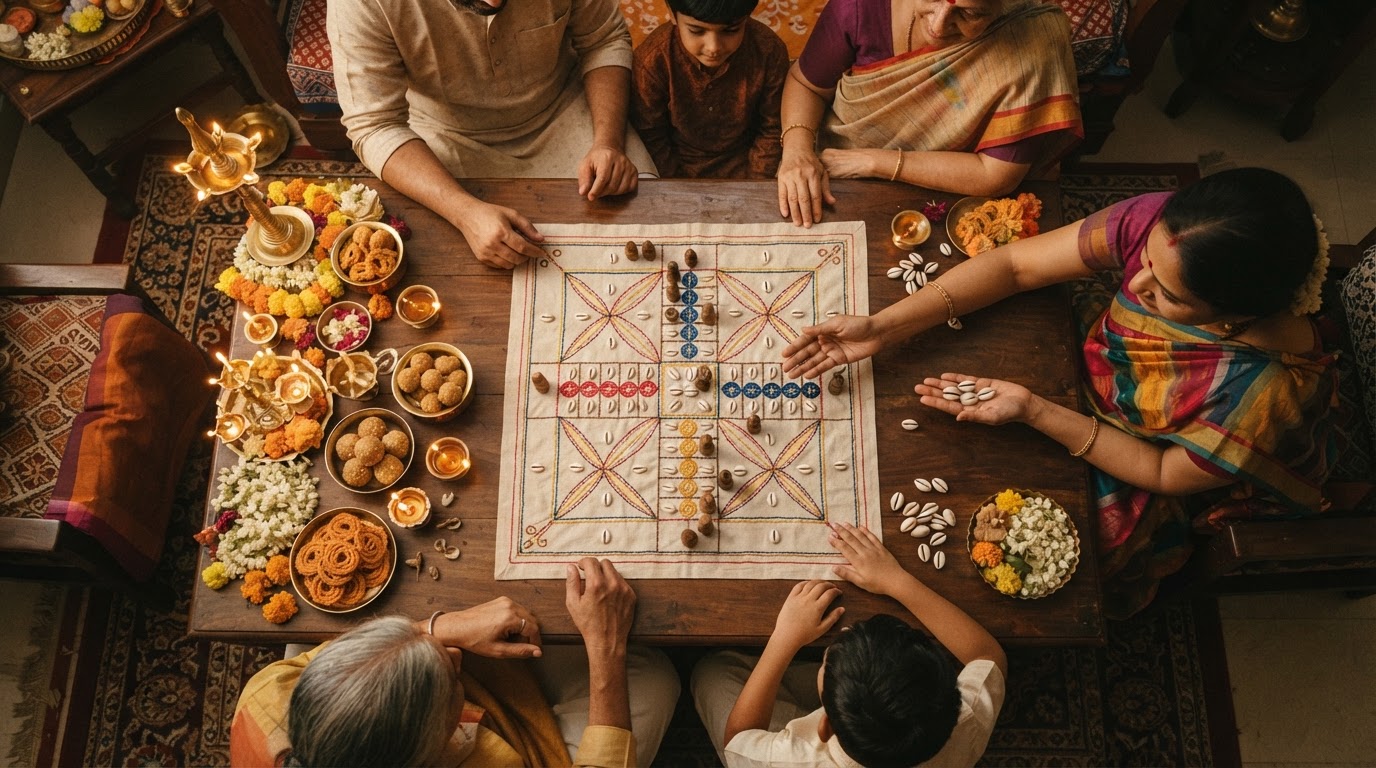
Pagadi is associated with India’s traditional cross-and-circle board-game family, with regional variations in boards, pieces, throws and captures. A November 16, 2026 report from Vijayapura in North Karnataka described a festive Pagadi gathering. That documents a local tradition, not a measured nationwide revival.
Why the November 2026 Story Matters
Games played within families can be overlooked when attention focuses on apps. The Vijayapura gathering illustrates how a regional game survives through festivals, friends and intergenerational teaching. The report should not be read as evidence that every household in Karnataka follows the same rules.
How to Learn Pagadi
Start by asking an experienced player to identify the board route, each team’s pieces and the throwing method. Some traditional formats use cowrie shells, but this varies. Confirm how a piece enters the board, whether an opponent can be captured, which squares are protected, whether special throws earn extra turns and how a player reaches home. Play a demonstration round before scoring.
Pagadi vs Pachisi vs Ludo
Pachisi names a broad historical Indian race-game tradition. Pagadi is a regional name associated with related play traditions. Modern Ludo uses a familiar printed cross-and-circle board and dice. These games share structural ideas but are not interchangeable: local rules can differ in equipment, captures, safe spaces and movement.
A Family-Friendly Pagadi Evening
Invite a relative who knows the local format, agree on rules, play a 20-minute practice round, then switch partners. Write down differences from Ludo and ask older family members about how they learned. Avoid money stakes. Preserve the rules you actually play rather than claiming a universal standard.
FAQ
Is Pagadi the same as Ludo? No, although both can belong to related race-game traditions. Is Pagadi new? No, the recent report covers an existing tradition. Is it suitable for children? Yes, with an accessible local ruleset. Does it use cowries? Some versions do; check the local rules.
Source: The Times of India, November 16, 2026. Related: Mahjong vs Teen Patti.
undefined
What the Source Confirms—and What It Does Not
The November 16 Times of India story identifies the Vajra Hanuman Mahila Mandali, a gathering at Savita Sudhindra Galagali’s home in Vijayapura, and two teams playing for nearly two hours. It describes younger women observing and a festive setting with refreshments. These are directly reported observations. The article also associates Pagadi with ancient tradition; however, a claimed Mahabharata-era origin should be treated as cultural attribution rather than a verified date of invention. The report supplies no survey of Pagadi participation, no measured trend line and no standardised rules manual.
A Game Family, Not a Single Rulebook
Cross-and-circle games share a basic spatial idea: pieces travel along a path, and players try to bring them home before opponents. That description alone cannot tell you how Pagadi works in a particular village. The number of pieces, board shape, throws, movement direction, safe positions and captures may all differ. Readers searching for ‘Pagadi rules’ should first identify their local variation. A page claiming that one dice-based Ludo rule is universally correct for Pagadi would be misleading.
A Reproducible Rules-Recording Worksheet
Use this seven-part worksheet when learning from a family member: (1) sketch the board and mark the start and home of each team; (2) count the playing pieces per team; (3) document the throwing objects and how each outcome is scored; (4) record the entry requirement; (5) mark safe squares; (6) note captures and bonus throws; (7) write down the exact winning condition. Test the written rules by playing a full practice round. If a disagreement arises, document both versions rather than silently choosing one.
Worked Example: Why a House Rule Changes Strategy
Imagine a hypothetical cross-and-circle game in which a player has two pieces, one near home and one exposed to capture. If the rules allow a captured piece to restart, moving the exposed piece may be urgent. If the rules prohibit capture on certain protected squares, advancing the near-home piece may be safer. This is an illustrative decision, not a claimed official Pagadi rule. The example shows why strategy cannot be explained responsibly until the exact local rules are known.
Pagadi, Pachisi and Ludo: What Can Safely Be Compared?
Compare games on six dimensions: board geometry, movement generator (cowries or dice), piece count, entry requirement, capture conditions and victory condition. Ludo typically has a commercially standardised board, but even Ludo has house-rule differences. Pachisi is an established historical label for a wider Indian game tradition. Pagadi should be described as a regional game name and practice, not automatically equated with a single commercial edition.
What Would Count as Evidence of a Revival?
One gathering shows continuity, not growth. A convincing revival claim would need comparable evidence across years: recurring club sessions, local tournament records, school participation, sales of traditional boards or carefully sampled interviews. Those data are not supplied by the Vijayapura report. The more defensible editorial conclusion is that a living regional tradition attracted fresh coverage during Deepavali 2026.
A 45-Minute Community Workshop
Minutes 0–10: an experienced player introduces the board and local vocabulary. Minutes 10–20: demonstrate throws and movement. Minutes 20–35: play an open-hand teaching round with questions allowed. Minutes 35–45: participants record differences from Ludo, photograph the board with consent and note the local name of the variant. The output is a reusable community rules sheet, not just a score.
Editorial Method and Limitations
This article combines attributed news reporting with comparative game analysis and a proposed documentation method. Rummy.land did not attend the Vijayapura event or interview the participants. No claim of hands-on testing or original field research is made. AI-assisted drafting was used; game-specific regional claims are intentionally qualified because authoritative rulebooks are not uniform.

Leave a Reply