Rummy.land Editorial | Educational game guide | Prepared November 17, 2026

Quick Answer
A pure sequence in common 13-card Indian Rummy is at least three consecutive cards of the same suit without a joker substituting for a missing card. It is normally mandatory for a valid declaration. Platform and house rules can differ, particularly around the use of a wild-joker rank as a natural card.
Valid Examples
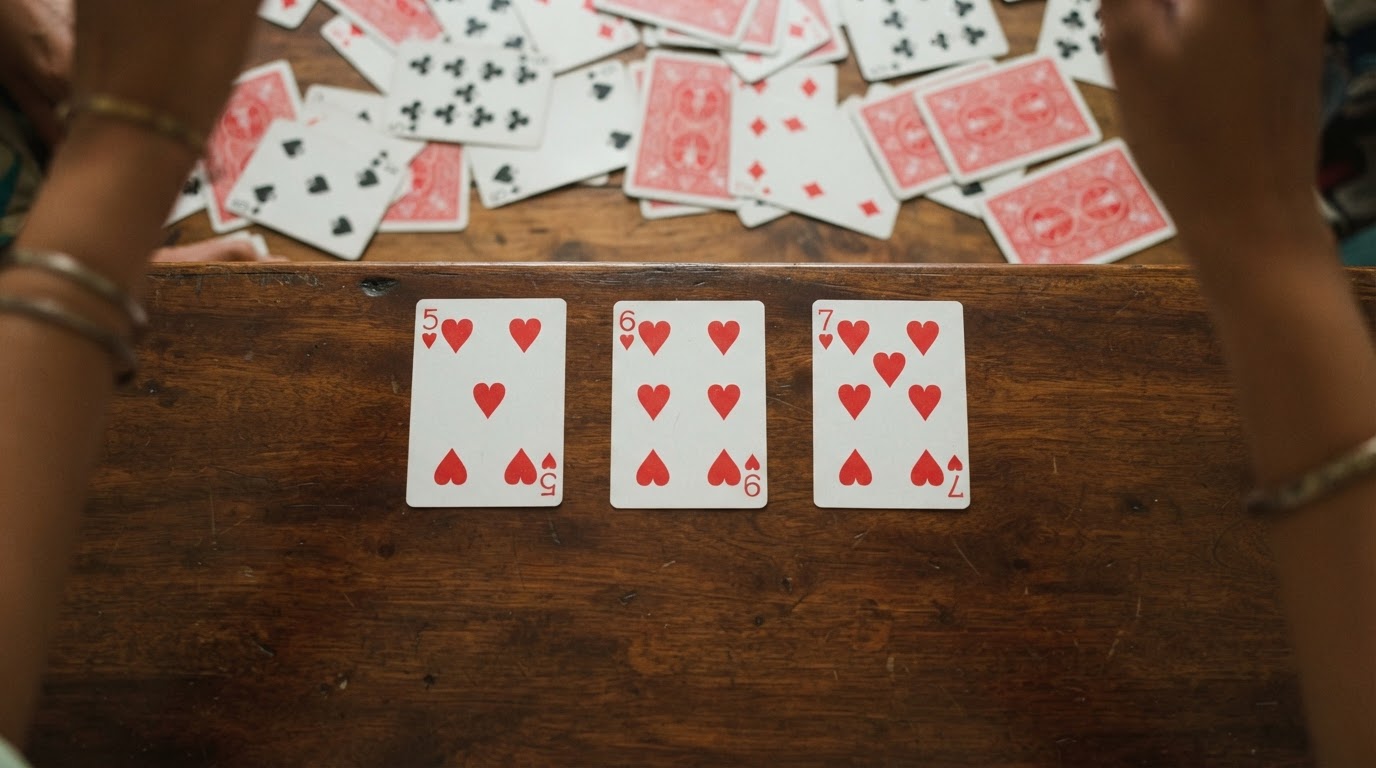
5♥–6♥–7♥ is a pure sequence. 10♣–J♣–Q♣ is another. A longer run such as 4♦–5♦–6♦–7♦ can also qualify in common formats. By contrast, 5♥–6♦–7♥ is invalid because the suits differ. 9♣–9♦–9♠ is a set, not a sequence.
Pure vs Impure Sequence
An impure sequence uses a joker as a substitute: 5♥–Joker–7♥ can represent 5♥–6♥–7♥ when the joker stands for the missing 6♥. This may be a legal sequence but does not replace the compulsory pure sequence. A printed joker is not automatically a natural card.
The Two-Sequence Requirement
A common 13-card declaration needs at least two sequences, one pure, with all remaining cards arranged into valid sequences or sets. One pure sequence alone does not make a winning hand. Check the exact game’s rules for joker ranks, group sizes and declaration scoring.
What About Aces?
Many Indian Rummy formats allow A–2–3 and Q–K–A within the same suit but not K–A–2. This is a common convention rather than an unconditional rule across every platform. Confirm Ace treatment before declaring.
Five Mistakes to Avoid
1. Mixing suits in a run. 2. Mistaking three equal ranks for a sequence. 3. Using a joker to fill a gap in the supposed pure sequence. 4. Wrapping K–A–2 when prohibited. 5. Declaring with unmatched cards even though a pure sequence is present.
Declaration Checklist
Before declaring, check: at least one pure sequence; at least two total sequences; all 13 cards grouped legally; correct Ace interpretation; correct treatment of printed and wild jokers. If any item fails, keep playing instead of declaring.
FAQ and Further Reading
Can a pure sequence have four cards? Yes, commonly. Are two pure sequences allowed? Yes. Is a pure sequence enough to win? No. Can a wild-joker-rank card appear naturally? Rules vary. See our full 13-card Indian Rummy guide and 101 Pool Rummy rules.
A Full 13-Card Example, Not Just a Three-Card Fragment
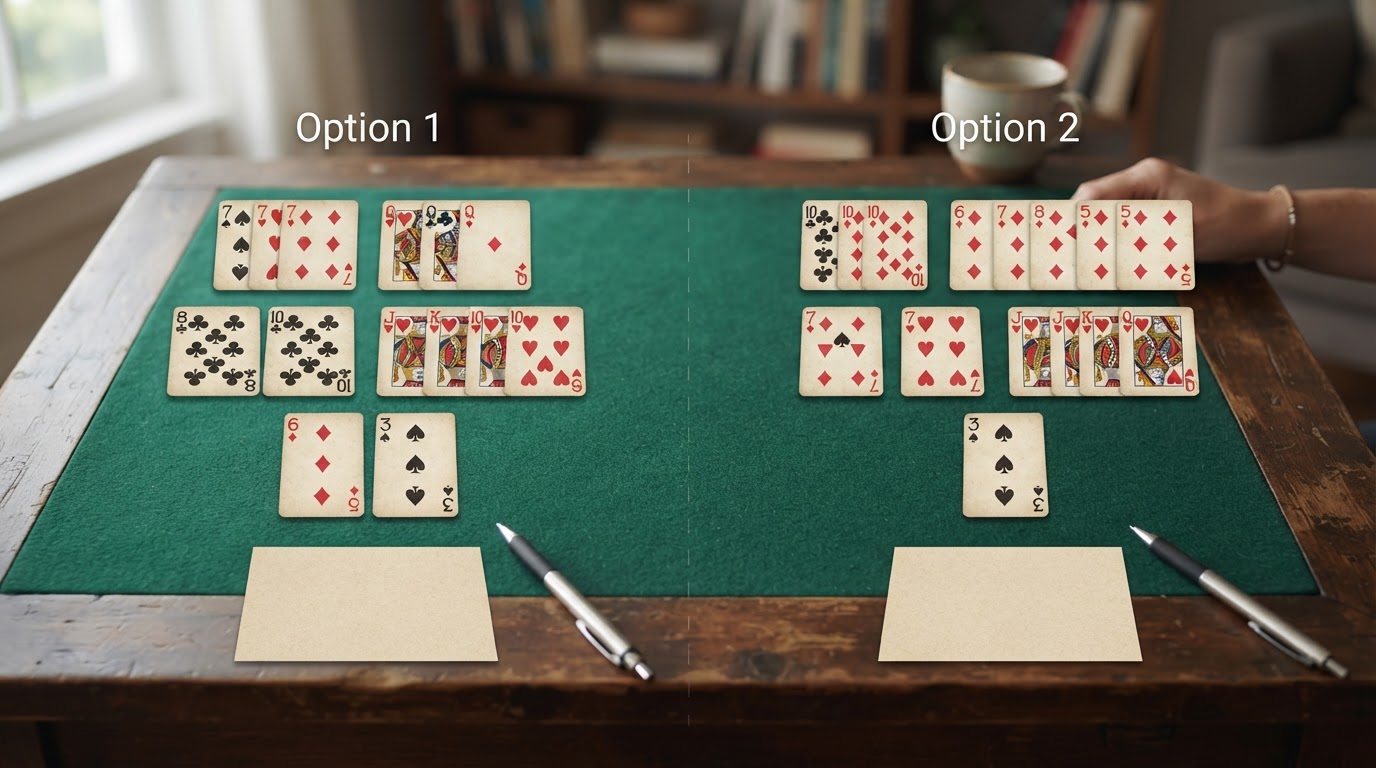
Consider these 13 cards: 4♥ 5♥ 6♥; 9♣ 10♣ J♣; 2♦ 3♦ 4♦; 7♠ 7♥ 7♦ 7♣. This is an illustrative hand grouped as three sequences and one four-card set. The first run is pure, the other two are also pure, and the final four cards form a same-rank set of different suits. In common 13-card Rummy formats this demonstrates a legal grouping pattern, subject to the specific game’s declaration rules. The cards total 3 + 3 + 3 + 4 = 13; checking the count is as important as recognising the patterns.
Pure Sequence vs Impure Sequence vs Set: A Diagnostic Table
5♥ 6♥ 7♥: pure sequence because all three cards are consecutive and share a suit. 5♥ Joker 7♥: impure sequence if the joker stands for 6♥. 8♠ 8♥ 8♦: set because ranks match but suits differ. 9♣ 10♦ J♣: invalid as a sequence because the middle suit differs. Q♠ K♠ A♠: commonly a high Ace sequence, but confirm the table’s Ace rule. These examples answer distinct questions and should not be treated as interchangeable.
The Joker Exception Requires Precise Language
A printed joker used to stand in for a missing rank normally makes a sequence impure. A card whose rank has been designated as a wild joker may, in some variants, be used as its natural printed rank in a same-suit run. Because platform rulebooks differ, do not assume that every joker-ranked card automatically breaks a pure sequence—or that it is always permitted. The safe approach is to inspect the game’s official rule text and apply it consistently.
Why Pure Sequences Matter Strategically
A mandatory pure sequence is a constraint on the whole hand. If you build only sets and joker-assisted runs, you may have many seemingly useful combinations but no valid declaration. One practical heuristic is to protect a promising same-suit natural run early, while still considering the overall hand. This is not a mathematically optimal strategy for every deal: the right discard depends on what you hold, what has been discarded and the scoring format.
How to Count Useful Cards Without Fake Precision
Suppose you hold 6♥ and 7♥. A 5♥ or 8♥ can extend them into a three-card run. Those are two ranks that complete a three-card pure sequence, subject to cards already visible or held elsewhere. Compare that with 6♥ and 8♥, which need 7♥ to fill the gap. Counting ‘outs’ can clarify choices, but an exact probability needs the number of unseen cards, deck composition, jokers and known discards. Quoting a universal percentage without those inputs would be misleading.
A Declaration Audit That Catches Most Errors
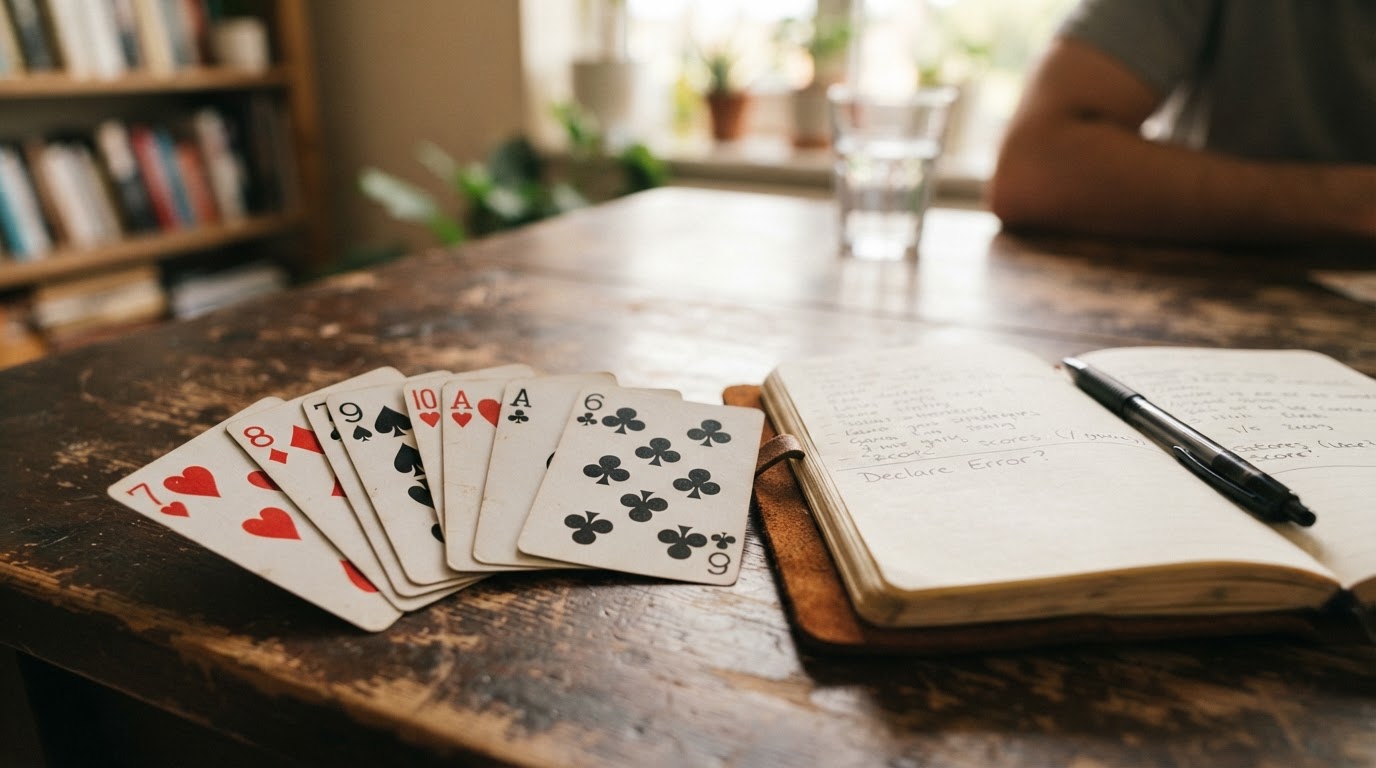
First count all 13 cards. Second underline every sequence and confirm at least two. Third circle one sequence that uses no substituting joker. Fourth check suits and rank order card by card. Fifth validate each remaining set and ensure repeated suits are not illegally used in a set where the format forbids them. Sixth confirm Ace and joker rules. Seventh ensure no card is counted in two groups. This checklist is more reliable than declaring merely because the hand ‘looks complete’.
A Five-Question Practice Quiz
1. Is 3♦ 4♦ 5♦ pure? Yes. 2. Is 3♦ 4♣ 5♦ pure? No. 3. Does 10♠ J♠ Joker count as pure if Joker replaces Q♠? No. 4. Is 6♣ 6♦ 6♥ a sequence? No, it is a set. 5. Can a hand with one pure sequence but no second sequence be declared? Not in the common 13-card format requiring two sequences. For each question, ask learners to explain the rule, not just memorise the answer.
Editorial Standards and Scope
This guide addresses common recreational 13-card Indian Rummy rules. It does not assert that every app, tournament or regional house format uses identical conventions. Examples are constructed illustrations, not claims of hands dealt or tested in live matches. AI-assisted drafting was used; the rules should be checked against the version being played. This is an educational game guide, not gambling advice.


Leave a Reply