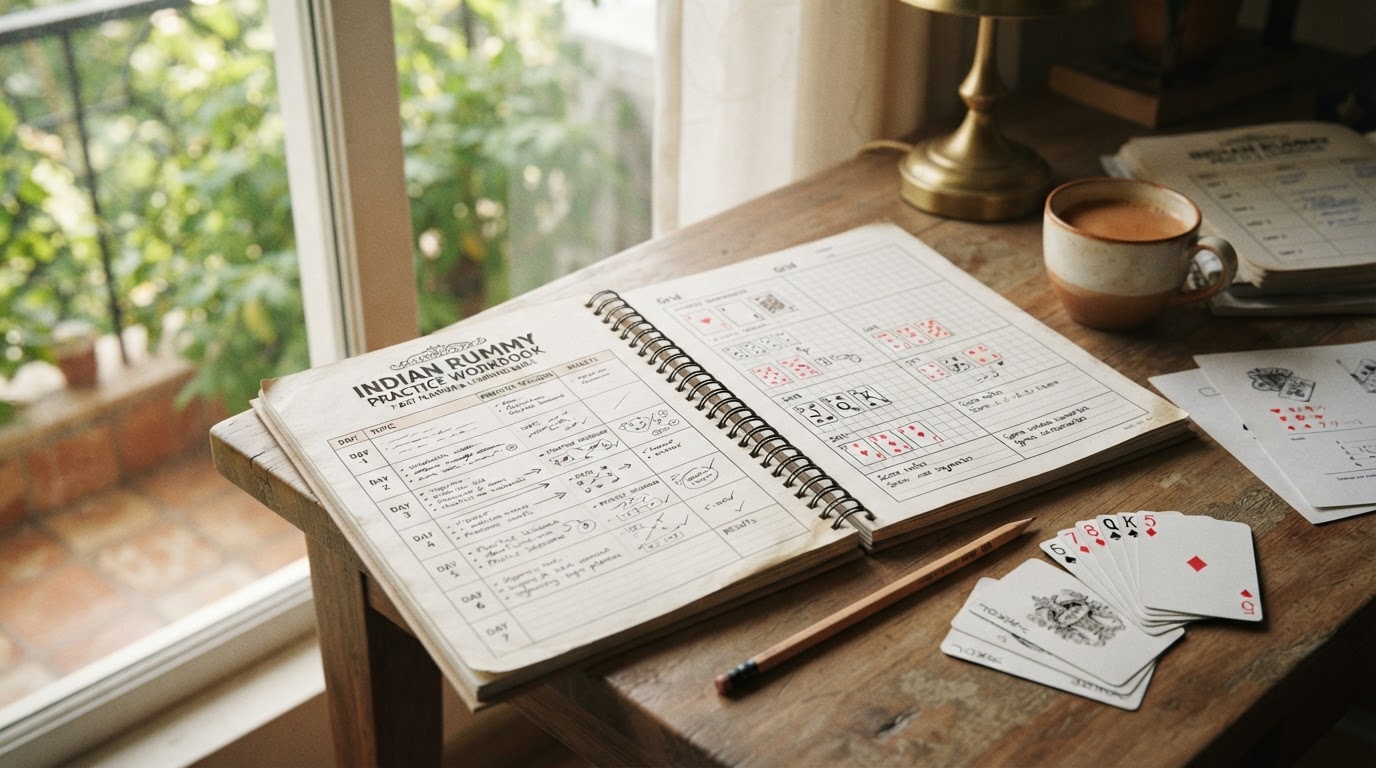
Practice improves when you isolate a decision and review it, rather than play many hands without recording why you acted. This seven-day workbook uses one skill per session. Use a free or non-monetary practice setting; the aim is rule fluency and decision quality, not guaranteed wins.
Day 1: classify groups
Sort 20 three-card groups into pure run, impure run, set or invalid. Include 4♥ 5♥ 6♥, 4♥ 🃏 6♥, 8♣ 8♦ 8♥ and 4♠ 5♥ 6♠. For every answer, write the rule (suit, rank, substitution or duplicate). Score yourself only after explaining each result.
Day 2: audit full hands
Take five 13-card hands and partition each card exactly once. Mark a pure run, a second sequence and leftover sets. Use 3♥ 4♥ 5♥ | 6♣ 7♣ 🃏 | 9♦ 10♦ J♦ | K♠ K♥ K♣ | A♣ as a diagnostic: it totals 13 but fails because A♣ is ungrouped. The lesson is to count and validate together.
Day 3: map joker substitutions
For each joker, write the exact card it represents. Test a one-gap run against a two-gap group. A joker can fill one missing rank; it does not make the sequence pure. Record any app-specific rule separately so you do not confuse a local variant with a general rule.
Day 4: estimate visible outs
For 8♣ 9♣, list 7♣ and 10♣ as immediate neighbors. Then remove any copies visible in your hand or the discard pile. Say “these are possible identities,” never “I will draw one.” Repeat with a pair at the edge of the sequence, where only one neighbor may work.
Day 5: practice discard explanations
Before discarding, note three things: current valid groups, the strongest route for each loose pair, and the point exposure of isolated cards. Choose a discard, then write one alternative and what information would change your choice. This prevents hindsight from making every discarded card seem obviously wrong.
Day 6: calculate unmatched points
Use the score table of the format you are practicing. Separate valid groups first, count each remaining card once, and only then apply a cap or penalty if the rules specify it. Compare your arithmetic with the worked points example.
Day 7: review the process
Review ten decisions. Mark whether you checked suits, counted cards, considered visible outs and used the right scoring rule. Do not grade only by outcome: a sound choice can lose to an unlucky draw, and a weak choice can get lucky. Pick one recurring error to practice next week.
Use the sequence trainer for the first drills and the declaration detective for whole-hand checks. Keep play within the rules and limits that apply to your game.



Leave a Reply