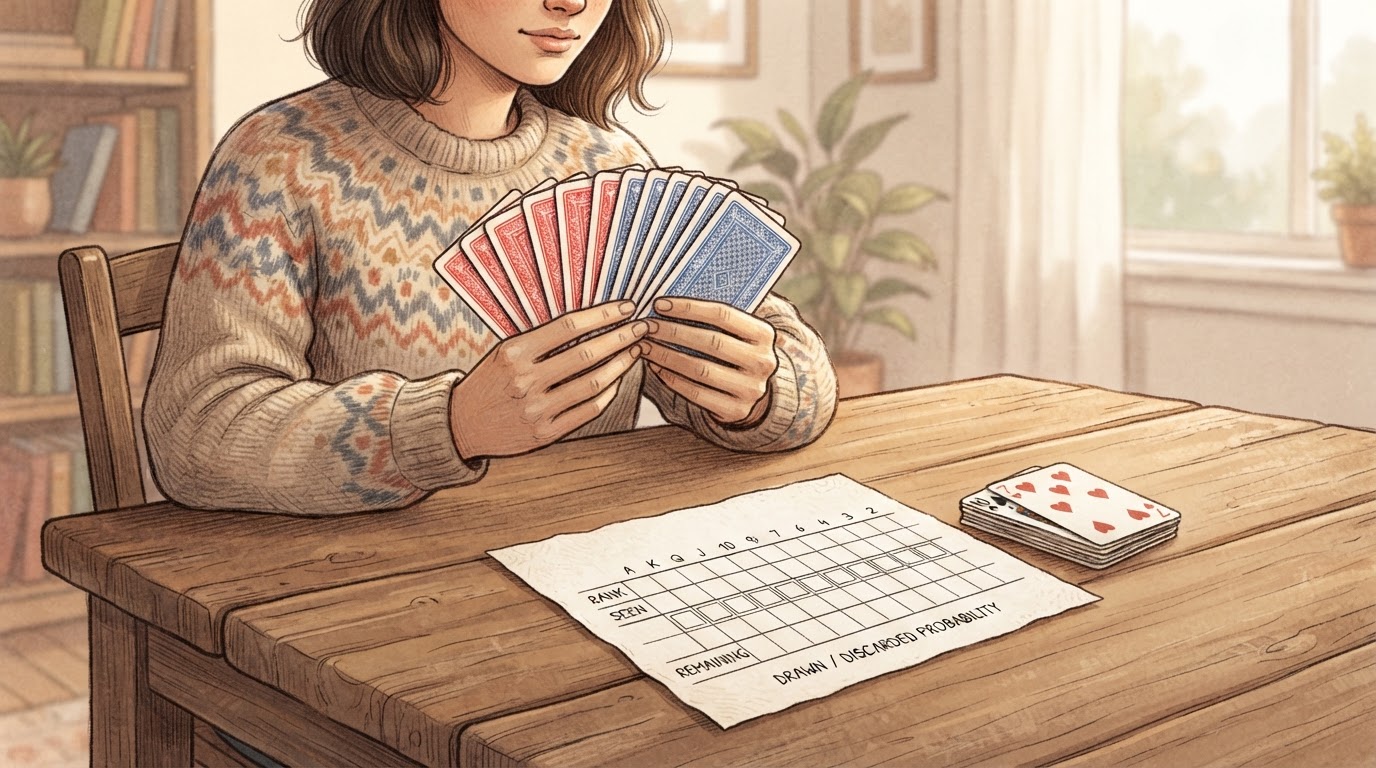
Players often say “I have four outs” as if that means a draw is likely. An out count is only a count of card identities that improve a particular plan. To estimate probability, you also need the unseen-card pool and the number of draws you will actually receive. This guide shows the arithmetic and its limits.
Start with a specific improvement
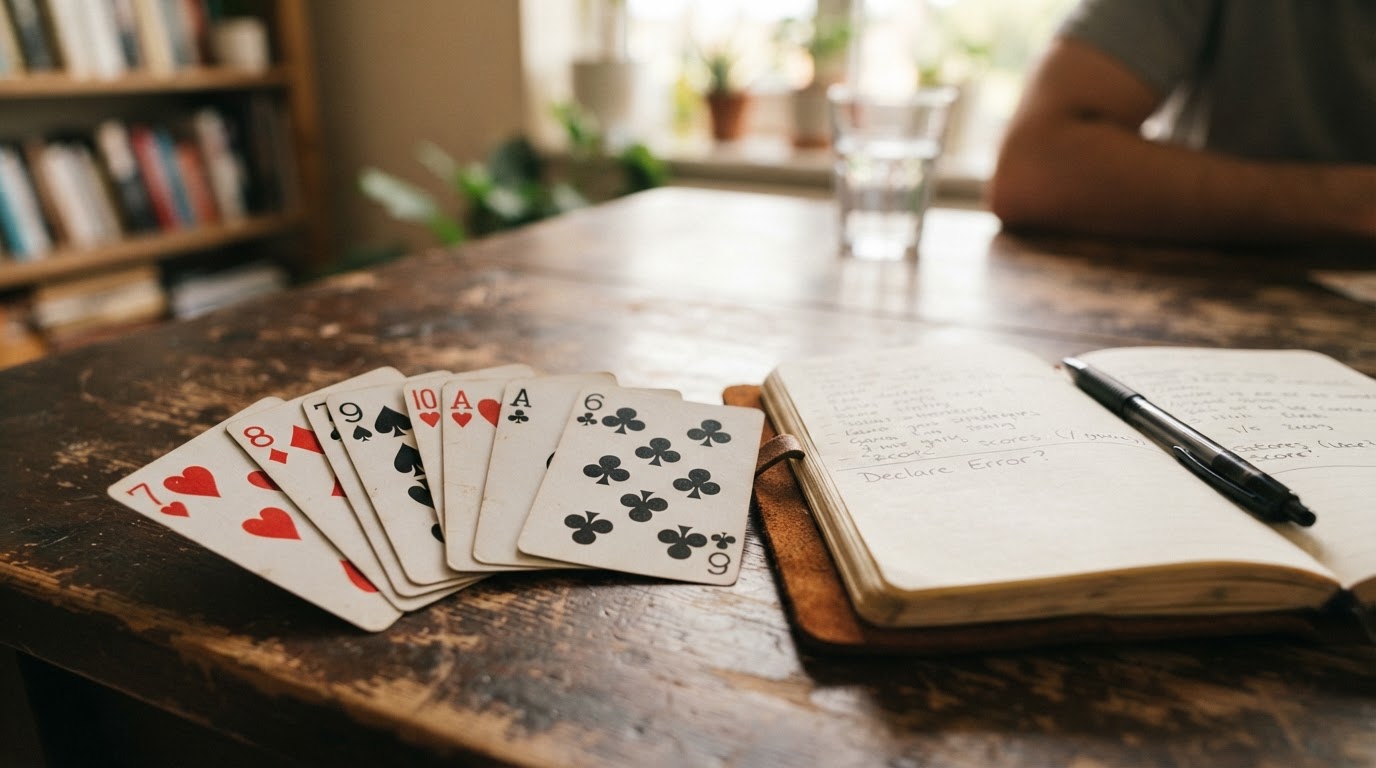
You hold 8♣ 9♣ and want to complete a three-card run. Immediate neighbors are 7♣ and 10♣, so there are at most two useful identities in a single deck. If one 7♣ is in your hand or face up in the discard pile, it is not an unseen out. If the 10♣ is visible too, this exact plan has zero unseen immediate outs. Do not count 6♣ or J♣: they do not complete this two-card group in one draw.
Use the unseen-card denominator
Suppose 20 cards are known between your hand and visible discards, leaving 32 unseen cards from a 52-card deck. If both 7♣ and 10♣ are unseen, there are two immediate outs. The chance of seeing one on the next single draw is 2/32, or 6.25%, under the simplified assumption that each unseen card is equally likely. If you see two draws without replacement, the chance is 1 − (30/32 × 29/31), about 12.3%. That is still far from a promise.
Why real tables are less simple
Cards held by opponents are unknown, not absent. A visible discard may be picked up, and some formats use more than one deck or jokers. You may also have multiple improvement paths, while a draw can make one path better and another worse. A probability estimate is meaningful only when the deck composition and known cards are stated.
Compare probability with hand value
A low-probability draw may still be worth waiting for early if it supports a strong hand; late in the round, a high-point singleton may matter more than a speculative pair. Probability answers “how often might this event happen under these assumptions?” It does not answer “is this the best discard?” Combine it with card value, turn timing and declaration requirements.
Practice the calculation
- Name the exact card identities that complete the group.
- Remove cards you hold and cards visible in the discard pile.
- Count the remaining unseen deck.
- For one draw, use outs divided by unseen cards.
- For multiple draws, account for draws without replacement and state the assumption.
For group validity, revisit the sequence examples. Then compare loose-card value in the points guide. Probability is a decision aid, never a guarantee of a particular draw.
Leave a Reply