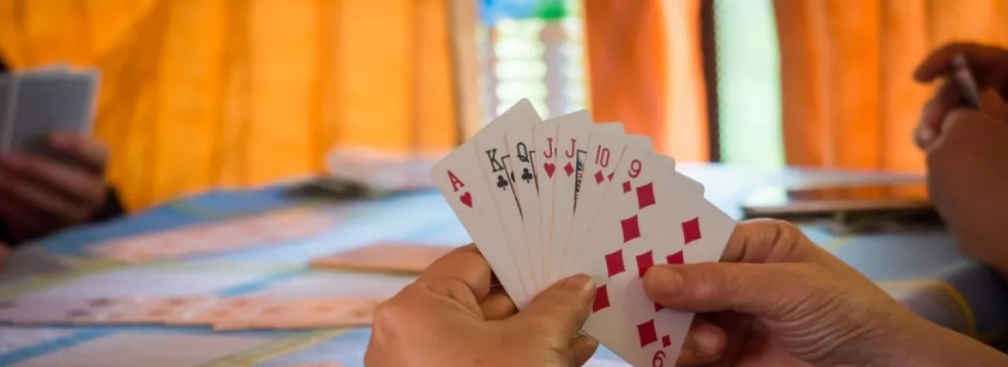
In India, a deck of playing cards is rarely just a box of paper. From bustling train journeys across the country to late-night family gatherings during Diwali, 13-Card Indian Rummy (often called Paplu) is woven into the fabric of everyday social life.

Unlike luck-driven card games, Indian Rummy is recognized as a deep game of skill. Success relies on memory, probability calculation, and reading your opponents’ psychology. Whether you are picking up the cards for the first time or looking to sharpen your competitive edge, this guide breaks down everything you need to master the table.
How 13-Card Indian Rummy Works
Indian Rummy is typically played between 2 to 6 players using two standard decks of 52 cards, plus two printed Jokers (106 cards in total). Each player is dealt 13 cards, and the remaining cards are placed face-down to form the Closed Deck, with one card placed face-up beside it to start the Open Deck.
The Golden Objective
Your goal is to arrange all 13 cards into valid combinations—specifically Sequences and Sets—and make a valid declaration before anyone else at the table.
The 3 Non-Negotiable Rules for a Valid Hand
Many beginners lose games not because of bad cards, but because of an invalid declaration. To win a round, your 13 cards must satisfy three strict conditions:
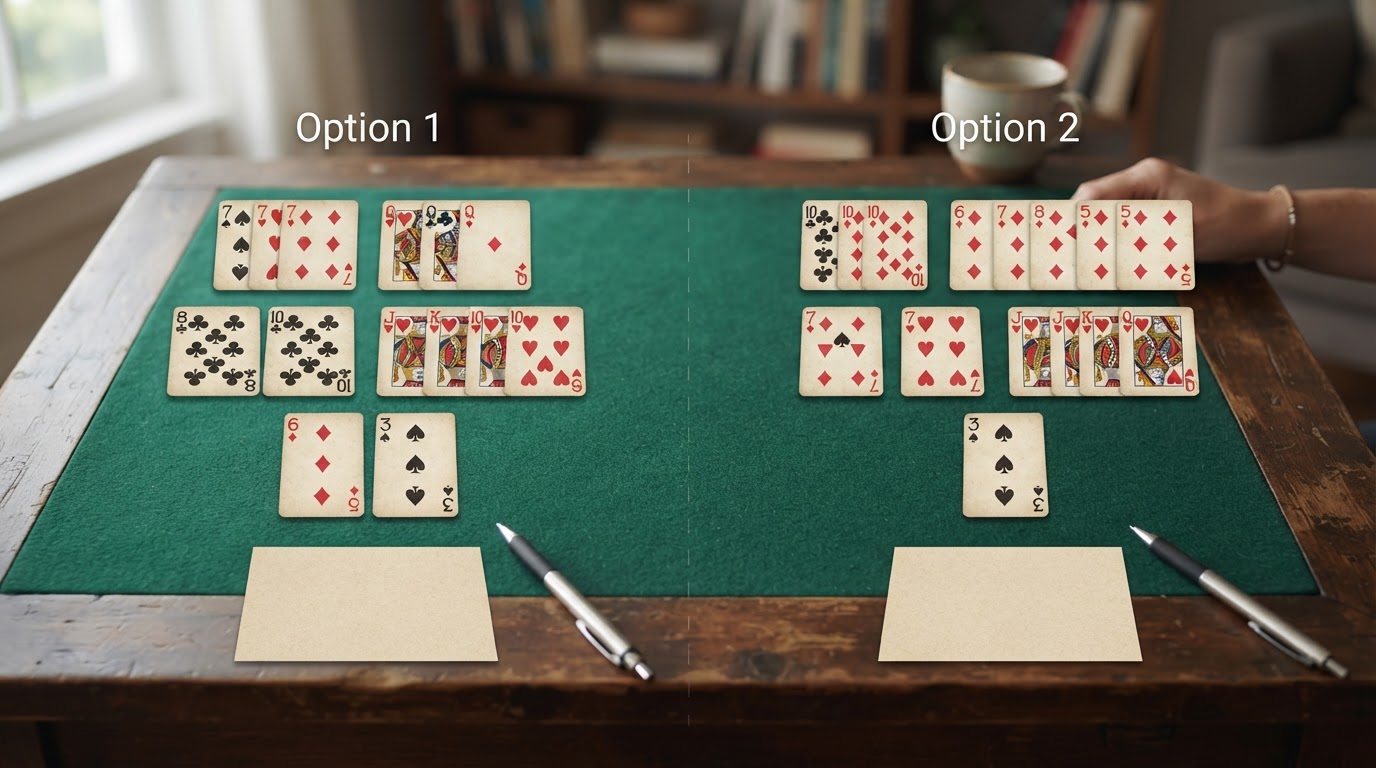
- Minimum Two Sequences: A sequence is a group of three or more consecutive cards of the same suit (e.g., 5♥ – 6♥ – 7♥). You must have at least two of them.
- At Least One Pure Sequence: A Pure Sequence is a run formed without the help of any Joker. Without a pure sequence, your entire hand is invalid—even if your other 10 cards are perfectly arranged.
- Sets or Extra Sequences: Once you have your two sequences (including one pure), the remaining cards can be grouped into either additional sequences or Sets (three or four cards of the same rank from different suits, such as 9♠ – 9♦ – 9♣).
Pro Rule Check: A Set cannot contain two cards of the same suit. For example, K♥ – K♥ – K♠ is invalid, even though two decks are used.
Understanding Jokers: Printed vs. Wild
Jokers are the wildcard engine of Indian Rummy, allowing you to substitute missing cards in impure sequences and sets. There are two types in every game:
- Printed Jokers: The two traditional Joker cards included in the decks.
- Wild Card Joker: At the start of every deal, one card is randomly drawn from the closed deck and placed beneath it. Every card of that exact rank—across all four suits—becomes a Wild Joker for that round. (For example, if 7♦ is drawn, then 7♠, 7♥, 7♣, and 7♦ all act as Jokers).
Note: If the Printed Joker is drawn as the Wild Card, then all Aces automatically become Wild Jokers.
How Points and Penalties Are Calculated
In Indian Rummy, points carry negative weight—the lower your score, the better. The winner of a deal scores 0 points, while losing players receive penalty points based on the ungrouped cards left in their hands:
- Face Cards (K, Q, J) & Aces: 10 points each
- Numbered Cards (2 through 10): Face value (e.g., a 6♠ equals 6 points)
- Jokers (Printed & Wild): 0 points
The 80-Point Cap Rule
- Invalid Declaration: If a player declares without meeting the mandatory sequence rules, they receive an automatic maximum penalty of 80 points.
- No Pure Sequence: If an opponent declares and you do not have a Pure Sequence, all 13 of your cards are counted—capped at a maximum of 80 points.
- With a Pure Sequence: If you already hold a valid Pure Sequence when an opponent declares, only your ungrouped cards are counted toward your penalty.
5 Proven Strategies to Outsmart Your Opponents

Moving from a casual player to a consistent winner requires shifting your focus from your own hand to the entire table.
1. Hunt for the Pure Sequence First
Never build sets before securing your pure sequence. Even if you hold three Kings early on, prioritize completing a natural run like 4♣ – 5♣ – 6♣. Once that safety net is locked in, your maximum possible loss drops dramatically.
2. Ditch High-Value Orphan Cards Early
If you are holding an ungrouped Ace, King, or Queen that does not connect to any nearby cards or Jokers, discard it within the first three turns. Holding onto dead high cards is the fastest way to get stuck with a 50+ point penalty.
3. Master the “Middle Card” Advantage
Middle-value cards (5, 6, 7, and 8) are statistically twice as flexible as Aces or Kings. A 6♠ can form a sequence in two directions (4-5-6 or 6-7-8), whereas a King can only connect downward (J-Q-K). Hold onto middle cards during the early turns.
4. Track the Open Discard Pile
Every time an opponent picks a card from the Open Deck, they are revealing their hand structure. If the player to your left picks up an 8♥, avoid discarding 7♥, 9♥, or 8♠ unless you are certain they cannot use them.
5. Use the “Bait and Switch” Trick
If you need a specific card—say, the 10♦ to complete 8♦ – 9♦ – 10♦—and you happen to hold an extra 10♠, discarding that 10♠ often tricks opponents into thinking you don’t need tens, prompting them to safely throw away the 10♦ on their next turn.
Frequently Asked Questions (FAQ)
Can an Ace be used in both high and low sequences?
Yes. In Indian Rummy, an Ace can form a low sequence (A♠ – 2♠ – 3♠) or a high sequence (Q♠ – K♠ – A♠). However, a wrap-around sequence like K♠ – A♠ – 2♠ is strictly invalid.
What happens if I hold two identical cards in a sequence?
A sequence must consist of consecutive ranks of the same suit, so duplicate cards cannot be part of the same sequence. You can, however, use the duplicate card to start a second, separate sequence.
When is the right time to “Drop” a hand?
In formats that allow dropping, if your initial 13 cards contain zero Jokers, zero close sequence connectors, and multiple unmatched face cards, taking an early First Drop (20 points) is mathematically smarter than playing on and risking an 80-point loss.

Leave a Reply