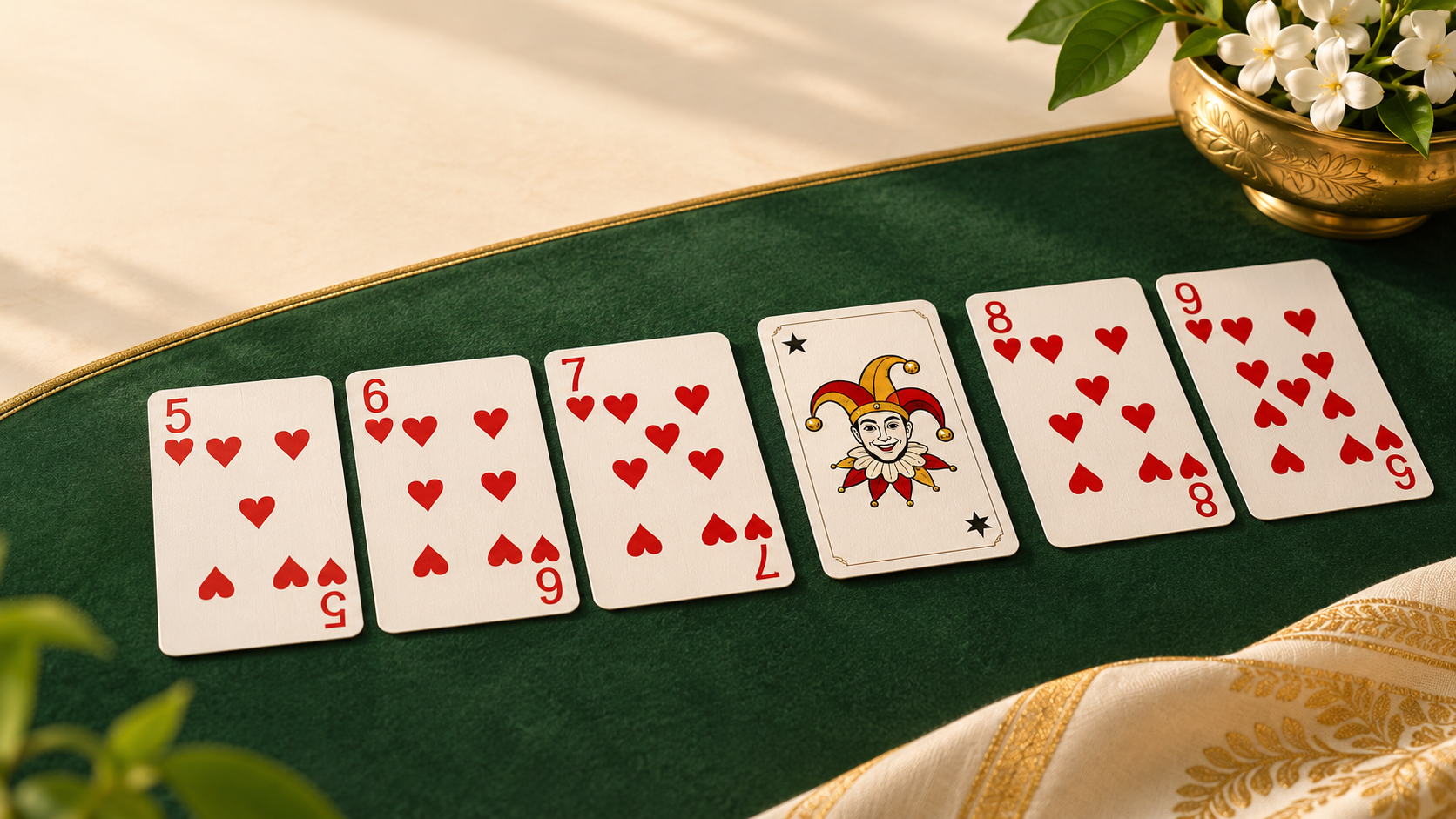
TL;DR: A pure sequence is three or more consecutive cards of the same suit without a Joker substituting for a missing card. An impure sequence uses a printed or wild Joker as a substitute. In common 13-card Indian Rummy, a valid declaration requires at least two sequences, including at least one pure sequence, and all 13 cards arranged into valid groups. Wild Jokers used as their natural card are an important platform-specific exception. This guide gives 30 annotated examples, complete 13-card hands, and a decision checklist.
Updated November 19, 2026 · By the Rummy.land editorial team. Educational rules analysis; no claim of professional tournament certification. We compare published rules and flag differences rather than treating every table as identical.
Pure vs Impure Sequence: Quick Comparison
| Question | Pure sequence | Impure sequence |
|---|---|---|
| Minimum cards | 3 | 3 |
| Same-suit consecutive run? | Yes | Yes, after substitutes are assigned |
| Printed Joker used as substitute? | No | Yes |
| Wild Joker used as substitute? | No | Yes |
| Counts as compulsory pure sequence? | Yes | No |
| Example | 4♥ 5♥ 6♥ | 4♥ PJ 6♥ (PJ = 5♥) |
The Five-Step Sequence Test
- Count: Are there at least three cards in the proposed group?
- Suit: Do the natural cards belong to one suit?
- Order: Can the cards form an uninterrupted rank run, allowing Ace low or high but never wrapping?
- Joker role: Does any Joker replace a missing rank? If yes, the group is impure.
- Declaration: Does the complete hand contain at least one pure sequence and a second sequence, with every remaining card grouped?
A group may be valid yet still fail the declaration test. For example, three sets and one impure sequence do not satisfy the compulsory pure-sequence requirement. Likewise, one pure sequence plus three sets lacks a second sequence.
30 Illustrated Card Examples: Valid, Invalid and Borderline
Notation: ♠ spades, ♥ hearts, ♦ diamonds, ♣ clubs; PJ = printed Joker. Where a wild rank matters, the example states it explicitly. The cards shown are text illustrations, not screenshots from any particular game. Each verdict applies to the described group, not necessarily the whole 13-card hand.
1. 3♠ 4♠ 5♠
Verdict: Pure. Why: Three consecutive spades; no substitute.
2. 9♥ 10♥ J♥ Q♥
Verdict: Pure. Why: Four consecutive hearts.
3. A♦ 2♦ 3♦
Verdict: Pure. Why: Ace is low.
4. Q♣ K♣ A♣
Verdict: Pure. Why: Ace is high.
5. 10♠ J♠ Q♠ K♠ A♠
Verdict: Pure. Why: Five-card high-Ace run.
6. 2♥ 3♥ 4♥ 5♥ 6♥
Verdict: Pure. Why: Five natural consecutive hearts.
7. 7♣ 8♣ 9♣
Verdict: Pure. Why: Ordinary three-card club run.
8. J♦ Q♦ K♦
Verdict: Pure. Why: Three consecutive court cards.
9. 4♣ 5♣ 6♣ 7♣
Verdict: Pure. Why: Four natural clubs.
10. 6♦ 7♦ 8♦
Verdict: Pure if sevens are wild under natural-use rule. Why: The 7♦ occupies its own rank and suit; confirm table rules.
11. 5♠ PJ 7♠
Verdict: Impure. Why: Printed Joker replaces 6♠.
12. 8♥ 9♥ PJ
Verdict: Impure. Why: Joker represents 10♥.
13. PJ Q♦ K♦
Verdict: Impure. Why: Joker represents J♦ or A♦.
14. 3♣ PJ 5♣ 6♣
Verdict: Impure. Why: Joker represents 4♣.
15. 10♦ J♦ PJ K♦
Verdict: Impure. Why: Joker represents Q♦.
16. A♠ 2♠ PJ
Verdict: Impure. Why: Joker represents 3♠.
17. Q♥ K♥ PJ
Verdict: Impure. Why: Joker represents A♥.
18. 4♠ 5♠ 9♦
Verdict: Impure if nines are wild. Why: 9♦ substitutes for 6♠; it is not used naturally.
19. 6♥ 8♥ 2♣
Verdict: Impure if twos are wild. Why: 2♣ represents 7♥.
20. PJ 7♦ 8♦
Verdict: Impure. Why: Joker represents 6♦ or 9♦.
21. 5♠ 6♥ 7♠
Verdict: Invalid. Why: Different suits, no Joker.
22. 5♣ 7♣ 8♣
Verdict: Invalid. Why: Missing 6♣ and no substitute.
23. K♦ A♦ 2♦
Verdict: Invalid. Why: No wraparound from King through Ace to two.
24. A♥ 3♥ 4♥
Verdict: Invalid. Why: Missing 2♥.
25. 9♠ 10♠ J♦
Verdict: Invalid. Why: Jack has the wrong suit.
26. 4♠ 5♠
Verdict: Invalid. Why: Only two cards.
27. 7♦ 7♥ 7♣
Verdict: Valid set, not sequence. Why: Equal ranks and distinct suits; cannot satisfy sequence requirement.
28. Q♠ Q♠ Q♥
Verdict: Invalid set. Why: Duplicate suit even if two decks contain both spade Queens.
29. 8♣ 9♣ 10♣ 10♣
Verdict: Invalid sequence. Why: Repeated rank breaks strict consecutiveness.
30. PJ 5♦ 6♦
Verdict: Impure. Why: Joker stands for 4♦ or 7♦, but never makes a pure sequence.
Three Complete 13-Card Hands, Explained
Hand A: Valid declaration with two pure sequences
4♥ 5♥ 6♥ | 9♣ 10♣ J♣ | 2♦ 3♦ 4♦ | 7♠ 7♥ 7♦ 7♣
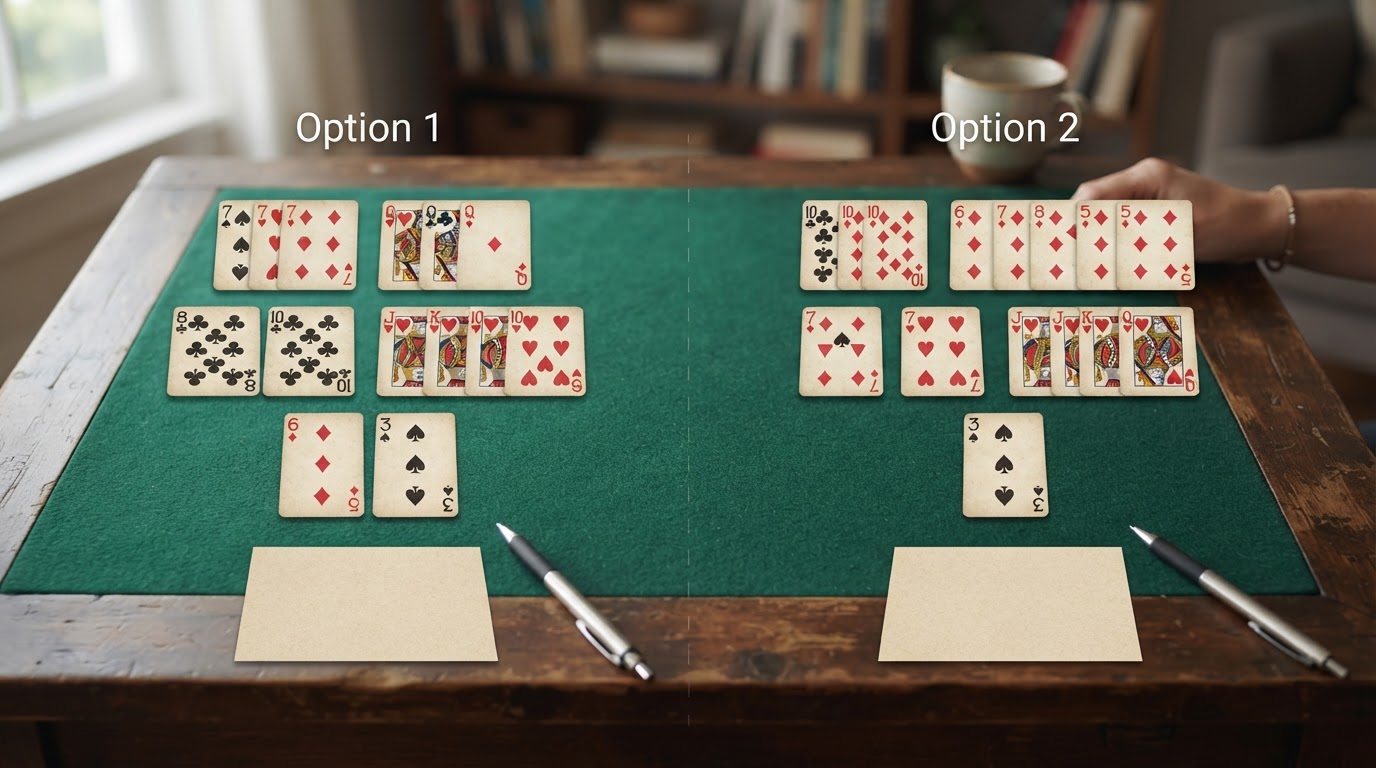
Count: 3 + 3 + 3 + 4 = 13. The first three groups are pure sequences. The last is a four-card set with four different suits. All cards are accounted for and the minimum two sequences, including a pure one, are present. This is a valid structural declaration under the common rules.
Hand B: Valid declaration with a Joker-assisted second sequence
3♠ 4♠ 5♠ | 8♥ 9♥ PJ | Q♣ Q♦ Q♥ | 2♣ 3♣ 4♣ 5♣
Count: 3 + 3 + 3 + 4 = 13. The spades and four-card clubs are pure sequences. The hearts plus PJ make an impure sequence when PJ stands for 10♥. The three Queens form a set. This hand satisfies the structure, provided the printed Joker is available in the game.
Hand C: Invalid declaration despite tidy groups
4♠ PJ 6♠ | 9♥ 9♠ 9♦ | K♣ K♥ K♦ | 2♣ 2♥ 2♦ 2♠
Count: 3 + 3 + 3 + 4 = 13. The first group is an impure sequence (PJ replaces 5♠). The remaining groups are sets. There is no pure sequence and no second sequence, so this is not a valid declaration. A neat-looking 13-card partition is not enough.
Joker Exceptions That Change the Answer
Wild Joker used naturally
Suppose sevens are the wild rank. The group 6♦ 7♦ 8♦ contains a seven, but it also contains a naturally consecutive run. Published guides such as Rummy.com and HowTo.cards allow a wild-rank card used in its original rank and suit to remain part of a pure sequence. Other individual game tables may classify every wild-rank card as a Joker even in its natural place. Check the specific platform before declaring; do not transfer one site’s rule blindly to another.
Printed Joker versus wild-rank card
A printed Joker has no natural rank or suit to occupy. If it appears in a run, it is substituting for a card, making that run impure. A wild-rank card is a real card with a printed suit and rank; whether its natural use preserves purity is the rule-dependent question.
Two decks and duplicate cards
Many 13-card Indian Rummy formats use two standard decks and printed Jokers. This allows identical-looking cards to exist twice, but it does not turn 8♠ 8♠ 9♠ into a consecutive sequence, nor make Q♠ Q♠ Q♥ a valid three-suit set. A set normally requires distinct suits.
Ace is low or high, never circular
A♣ 2♣ 3♣ and Q♣ K♣ A♣ are commonly valid. K♣ A♣ 2♣ is not a run: the rank order cannot wrap around. Aces are not interchangeable with Jokers.
How to Analyse a Difficult Hand Without Guessing
- Identify a natural three-card run before allocating any Joker. Protecting a pure sequence is a useful starting point.
- Look for a second sequence. It can be pure or impure; a set does not replace it.
- Assign Jokers only after deciding which gaps matter. One Joker cannot simultaneously belong to two groups.
- Check that every group has at least three cards and that sets use different suits.
- Recount all 13 physical cards exactly once. A card shown in two groups is not a valid declaration.
- Confirm the exact game’s Joker, duplicate-card, Ace and declaration rules.
Try the Joker Challenge to practise substitutions, the Declaration Detective for full-hand judgments, or the Rummy Hand Solver for a simplified interactive grouping demonstration. The current solver is not a universal two-deck rules engine.
Common Mistakes and Their Corrections
| Mistake | Why it fails | Better check |
|---|---|---|
| Counting a set as the second sequence | Sets and sequences are different group types | Find two separate runs |
| Using a printed Joker in the pure sequence | It substitutes for a missing card | Build a natural run |
| Wrapping K-A-2 | Ace is high or low, not circular | Use Q-K-A or A-2-3 |
| Mixing suits | Natural sequence cards must share a suit | Match suit before checking rank |
| Using one card twice | Every physical card can appear in only one group | Recount 13 unique card positions |
| Assuming all platforms treat natural wild cards identically | Table-specific exception | Read the applicable rulebook |
FAQ
Can I declare with one pure sequence and one impure sequence?
Yes, if every remaining card also belongs to valid groups and all other table rules are satisfied. You do not ordinarily need two pure sequences.
Can I use two Jokers in an impure sequence?
Some rulesets permit multiple Joker substitutions, but a valid run still needs a coherent suit and consecutive rank assignment. Requirements for natural-card anchors and Joker-only groups vary by platform; consult its rules.
Is 6♣ 7♣ 8♣ pure if sevens are wild?
It is treated as pure under published rules that allow natural use of a wild-rank card, including Rummy.com. Some individual platforms instead treat it as impure. Verify before declaring.
Does a valid set count as a pure sequence?
No. A set groups equal ranks of different suits; a sequence groups consecutive ranks of one suit.
Can I use K-A-2 as a sequence?
No, not under the commonly documented Ace-high/Ace-low convention. Q-K-A and A-2-3 are valid patterns.
Can the Rummy.land Hand Solver verify every Indian Rummy game?
No. It is a learning tool with a simplified deck and Joker model. Use the specific platform’s rules to settle edge cases.
Editorial Method and Sources
We checked the examples against published 13-card rules, including sequence length, suit continuity, Ace positioning, Joker substitutions, set structure and full-hand declaration requirements. Wild-rank natural-use differences are disclosed explicitly. The 30 card arrangements and three complete hands above are explanatory examples created for this guide, not claims about observed gameplay or measured outcomes.
- Rummy.com — Learn Rummy Card Game Rules (PDF): sequence and declaration requirements, including natural-use wild Joker exception.
- HowTo.cards — Indian Rummy Rules: two-deck setup, sequences, sets, Ace order and Joker handling.
- RummyDen — Game Rules: example of a platform that treats natural wild-rank cards differently.
Educational information only. Rule interpretations can differ by platform and format. For more practice, browse all free Rummy learning tools.

Leave a Reply