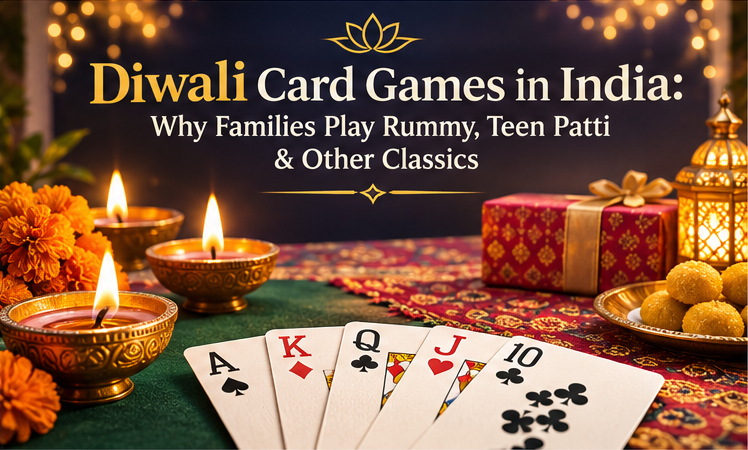
TL;DR: Card games are part of some Indian families’ Diwali social traditions, but customs differ by household and region. Teen Patti is closely associated with festive card gatherings; Rummy and other simple games also work for non-monetary family play. This guide offers a practical 30-minute, no-stakes card-night plan, clear beginner rules, age-appropriate alternatives and a careful explanation of India’s 2026 online gaming framework.
Rummy.land editorial guide · Prepared November 20, 2026 · Educational information, not legal or financial advice. Examples are original teaching scenarios, not reported gameplay or measured popularity. Game variants and local practices differ.
Why Card Games Appear at Diwali Gatherings
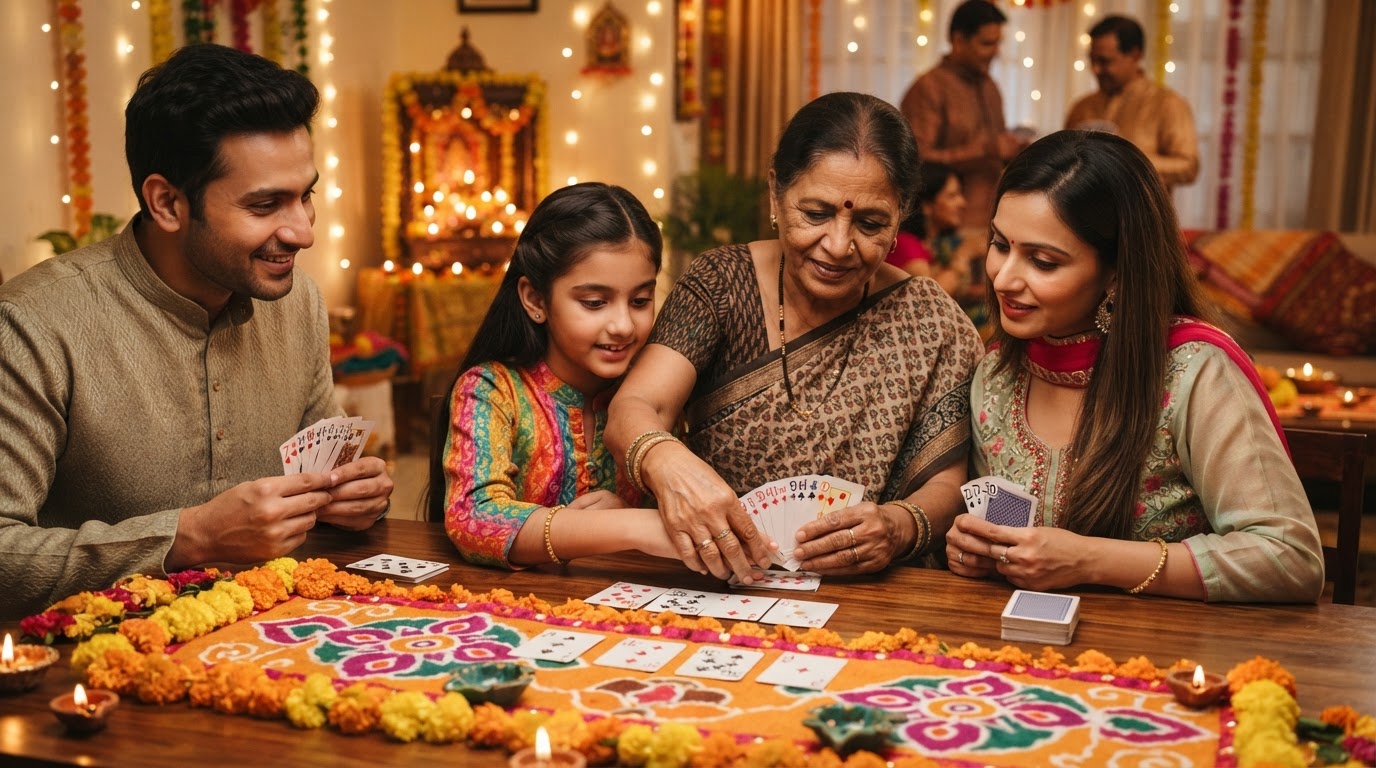
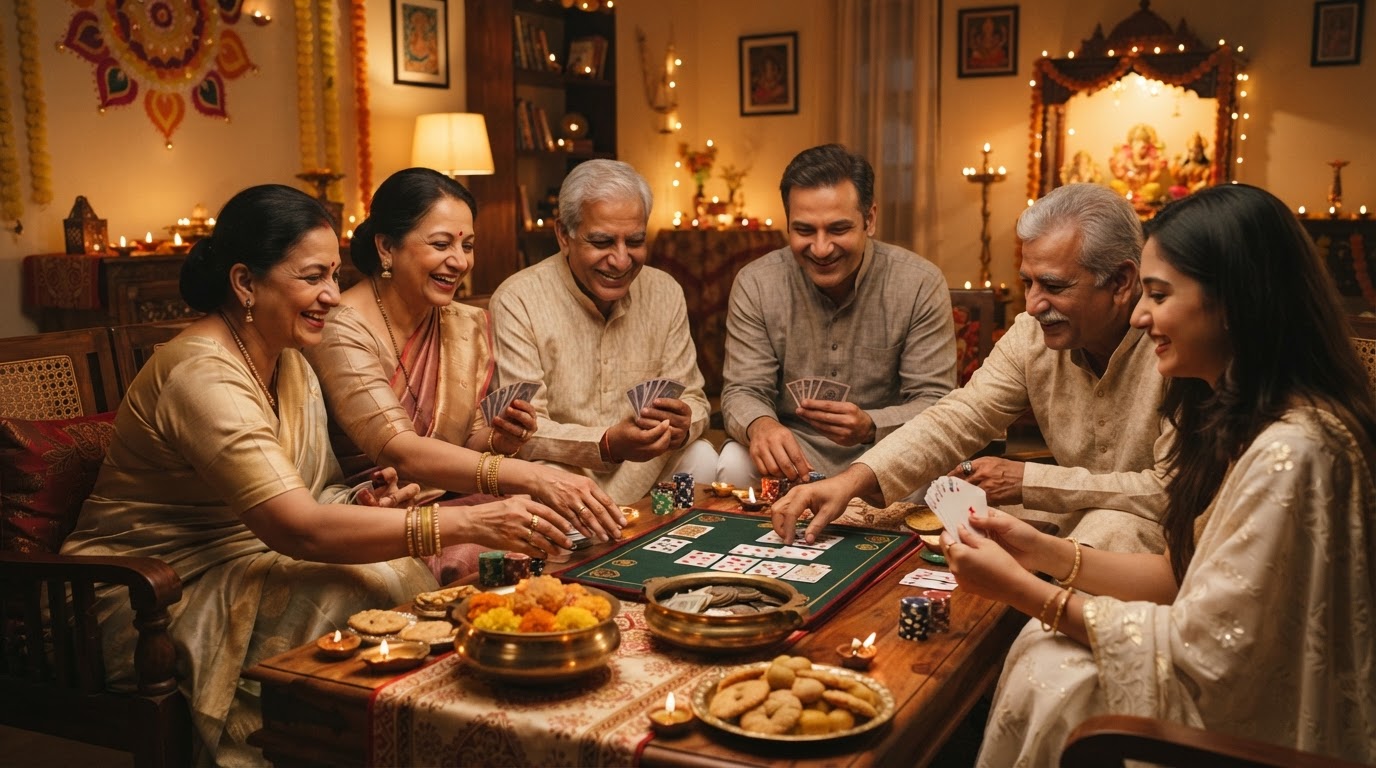
Diwali is celebrated through varied regional and family practices involving lights, visits, food, gifts and time together. In some households, card games—especially Teen Patti—are a familiar social activity. Popular explanations connect festive card-playing with Lakshmi, prosperity and traditional stories, but these accounts are not uniform across India and should not be treated as a single universally documented origin. For many families, the immediate appeal is simply shared attention and playful conversation.
Four Card Games for Different Groups
| Game | Best for | Typical teaching time | Family-friendly adaptation |
|---|---|---|---|
| Teen Patti | Adults who enjoy quick three-card rankings | 5–10 minutes | No money, compare hands only |
| 13-card Indian Rummy | Players who enjoy sequences and sets | 10–15 minutes | Teach pure sequences with open cards first |
| Matching pairs / memory | Children and mixed-age groups | 2–5 minutes | Face-down matching, no betting |
| Simple high-card challenge | Very young beginners | 1–2 minutes | Draw one card, compare ranks |
Teen Patti: A Three-Card Mini Lesson
In a common Teen Patti ranking, trail/trio outranks pure sequence, which outranks sequence, colour, pair and high card. House rules may differ on Ace and tie-breakers. To teach without stakes, deal three cards to each player, reveal them and classify them together. Avoid the betting component entirely.
| Hand | Classification | Explanation |
|---|---|---|
| 9♠ 9♥ 9♦ | Trail | Three of a kind |
| 5♣ 6♣ 7♣ | Pure sequence | Consecutive and same suit |
| 10♠ J♥ Q♦ | Sequence | Consecutive mixed suits |
| A♥ 8♥ 3♥ | Colour | Same suit without run |
| K♠ K♣ 2♦ | Pair | Two Kings |
Rummy: A Sequence Puzzle for the Whole Table
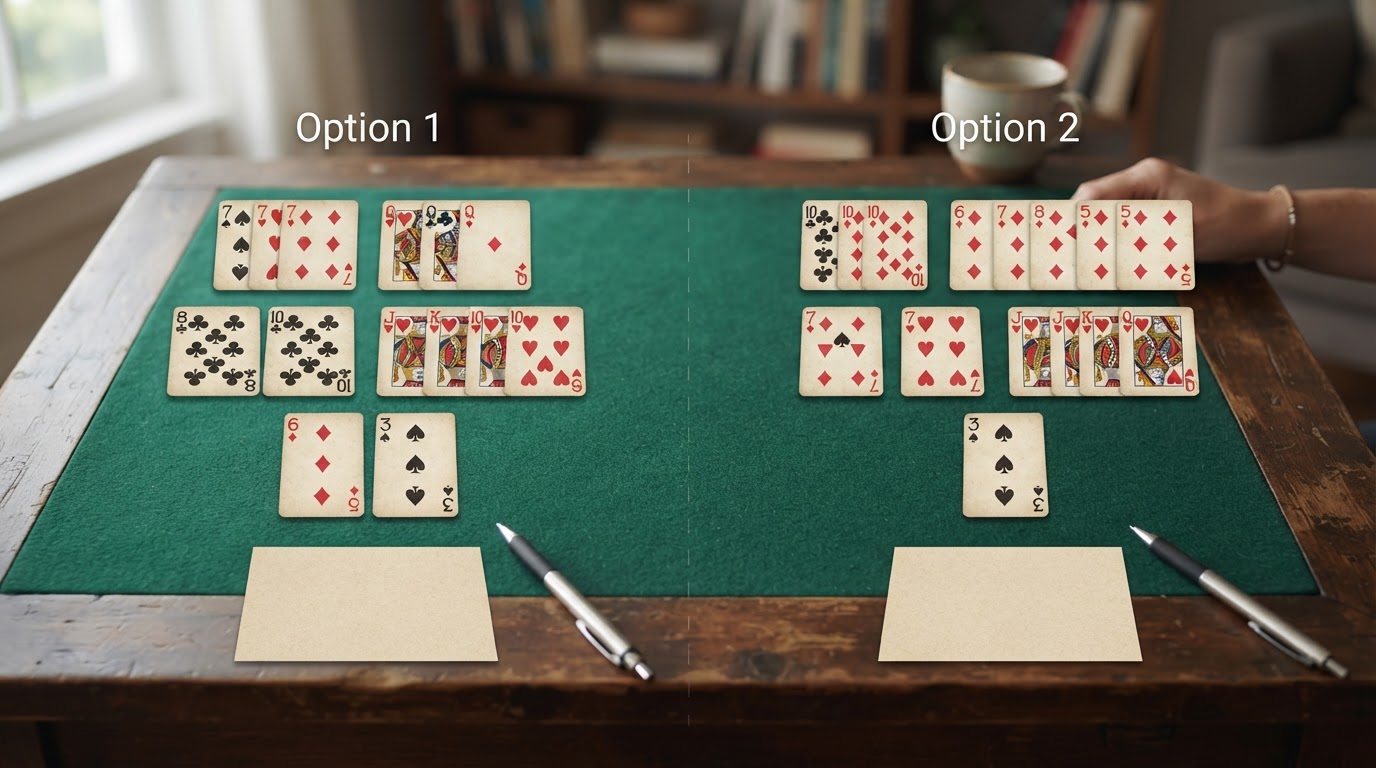
In 13-card Indian Rummy, a pure sequence contains three or more consecutive cards of the same suit without a substituting Joker. For a full declaration, common formats require at least two sequences, one pure, and every card arranged into valid groups. For beginners, start with only six or nine face-up cards and ask players to identify possible sequences before moving to a full hand.
Try the Sequence Trainer and the 30 illustrated sequence examples.
A 30-Minute No-Stakes Diwali Card Night
| Minute | Activity | Materials | Learning goal |
|---|---|---|---|
| 0–5 | Explain card suits and ranks | One ordinary deck | Understand symbols |
| 5–10 | Three-card Teen Patti hand ranking | Deck and ranking sheet | Compare patterns |
| 10–18 | Rummy pure-sequence challenge | Face-up cards | Build same-suit runs |
| 18–25 | Team puzzle: identify an invalid group | Prepared example cards | Explain why a pattern fails |
| 25–30 | Family quiz and celebration | Score sheet or stickers | Recognise learning, not winnings |
Keep the event accessible: use large-print cards where helpful, let young children match colours rather than play a full Rummy hand, and give every team a chance to explain its reasoning. No entry fee, wagering, cash prize or redeemable token is needed.
Five Ready-to-Use Family Puzzles
| Prompt | Answer | Teaching point |
|---|---|---|
| 3♥ 4♥ 5♥: pure Rummy sequence? | Yes | Consecutive same suit |
| 3♥ 4♣ 5♥: pure sequence? | No | Mixed suits |
| K♠ A♠ 2♠: Rummy sequence? | No | Ace does not wrap |
| Teen Patti 7♣ 7♦ 7♥: rank? | Trail | Three equal ranks |
| Teen Patti 6♠ 7♠ 8♠: rank? | Pure sequence | Three-card straight flush |
The Cultural Difference Between Celebration and Gambling
Some festive card-playing traditions involve stakes, but family celebration does not require wagering. This guide intentionally recommends no-stakes play. Do not infer that a cultural association makes a particular paid online product legal. India’s national online gaming rules effective May 1, 2026 distinguish online money games from social games using economic criteria, including stakes and expected enrichment. Read our 2026 legal guide for the details. Local laws and household preferences may impose additional considerations.
Hosting Checklist: Make It Inclusive
- Choose a comfortable table with good lighting and enough space for cards.
- Explain house rules before dealing, especially Ace order and ties.
- Use points or stickers solely as non-redeemable recognition, not money-equivalent rewards.
- Let players observe a round before joining; never pressure someone to participate.
- Provide a simpler matching activity for children or guests unfamiliar with the deck.
- Pause for snacks, conversation and the broader festival; the cards are optional entertainment.
Diwali Timing and Evergreen Planning
Diwali’s date follows a lunisolar calendar and changes each Gregorian year. This guide is intended as a reusable family activity resource, not a claim that Diwali occurs on the article’s publication date. Before planning an event for any future year, confirm the relevant local calendar and community observances. Regional celebrations can span several days.
Frequently Asked Questions
Is Teen Patti the only Diwali card game?
No. Teen Patti is well known in some festive gatherings, while families may choose Rummy, matching games or any non-monetary activity they enjoy.
Do you need to bet to play Teen Patti?
No. A family can simply deal and compare hands without money, stakes or prizes.
Can children learn Rummy sequences?
Children can practise suit and rank recognition with open-card puzzles. Adult supervision and age-appropriate activities are preferable to betting-oriented formats.
Is K-A-2 a valid Rummy sequence?
Not under the commonly used Ace-high/Ace-low convention. Q-K-A and A-2-3 are valid patterns; K-A-2 wraps around and is not.
Can we play free online Rummy in India?
The 2026 framework recognises online social games, but product-specific classification depends on mechanics, fees, rewards and other facts. A free label alone is not proof of regulatory approval.
Editorial Sources and Cultural Limits
This article separates practical original family activity ideas from broader cultural observations. There is no claim that all Indian households play cards at Diwali or that any specific myth explains the practice everywhere. For online-game legal distinctions, see the official Act and MeitY 2026 Rules explanation. For Rummy mechanics, consult our linked 30-example sequence guide and verify the house variant being played.
Explore all free Rummy learning tools.
Leave a Reply