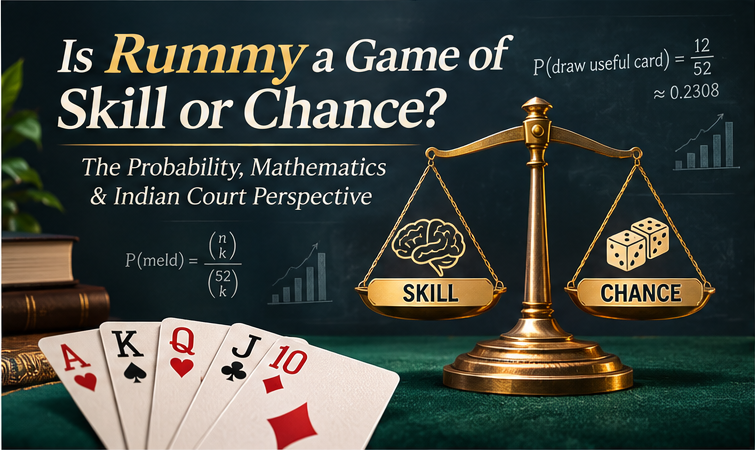
TL;DR: Rummy involves both randomness and decisions. A shuffled draw determines which cards appear; a player chooses what to retain, discard and declare. A simple probability model demonstrates chance, while conditional decisions demonstrate skill. Indian judicial history has recognised meaningful skill in Rummy, but the 2026 online-money-game framework does not exempt paid-stakes games merely because they involve skill.
Rummy.land editorial guide · Prepared November 20, 2026 · Educational information, not legal or financial advice. Examples are original teaching scenarios, not reported gameplay or measured popularity. Game variants and local practices differ.
The Question Has Three Different Meanings
| Question | What it asks | Appropriate evidence |
|---|---|---|
| Is the next card random? | Chance in the physical draw | Combinatorics |
| Can decisions improve outcomes? | Skill in play | Decision models and controlled tests |
| How does law classify a paid-stakes online service? | Statutory and judicial issue | Primary laws and court judgments |
Probability 101: A Card Is Random, a Decision Need Not Be
Take a simplified single standard deck of 52 cards without Jokers. Suppose you hold 13 distinct cards, and exactly four of the remaining 39 cards would immediately complete a particular desired group. If you draw one uniformly from the unseen 39, the probability of a useful draw is 4/39 ≈ 10.26%. This is a toy model, not the probability of winning a real Indian Rummy game. Real 13-card formats commonly use two decks and Jokers, the discard pile provides information, and several overlapping groups may be useful.
Two draws without replacement
If there are 4 useful cards among 39 unknown cards, the probability of seeing at least one in two blind draws without replacement is 1 − (35/39 × 34/38) ≈ 19.97%. The calculation is transparent and reproducible. It assumes no reshuffle, no other players removing cards and no changes in what counts as useful.
Why Skill Matters: Conditional Choices
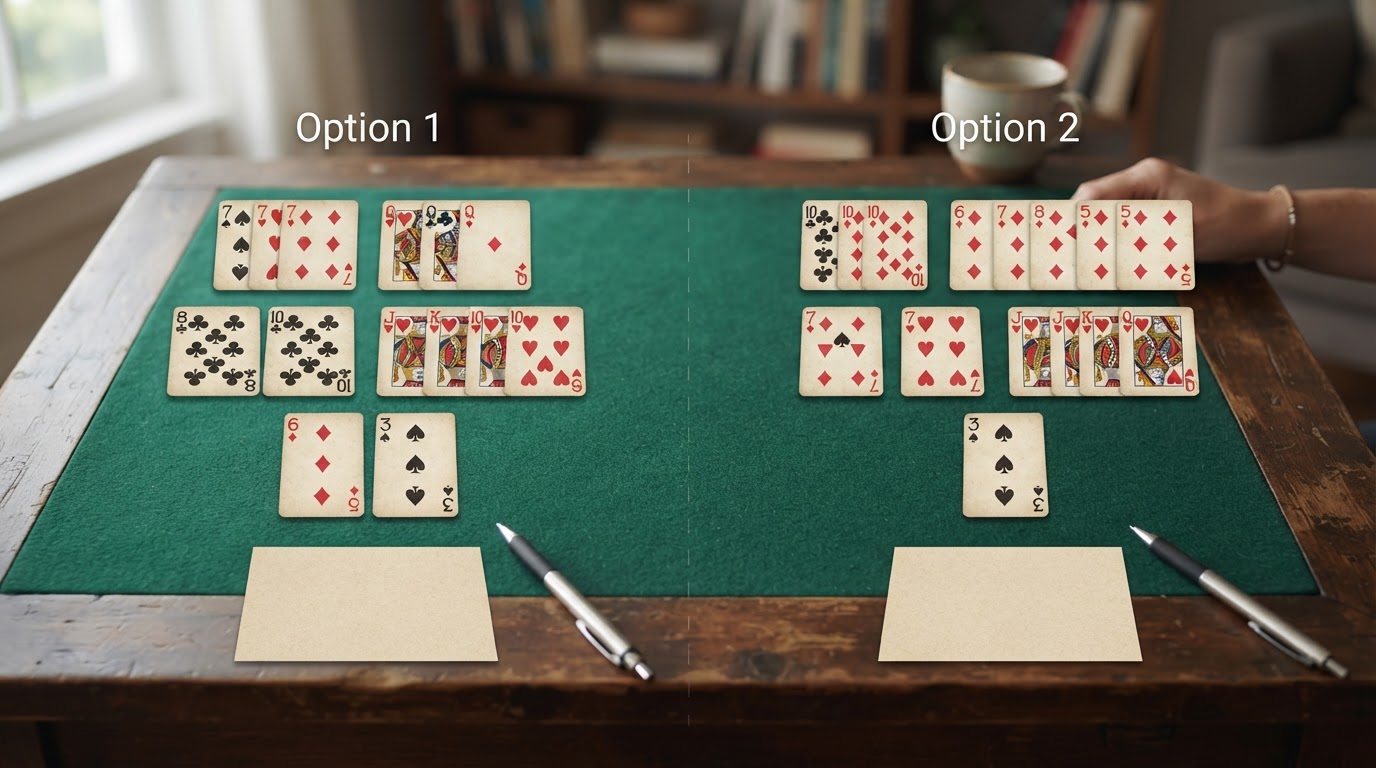
Consider a toy choice between keeping a natural 4♥ 5♥ 6♥ pure sequence and breaking it to chase an uncertain four-card run. Protecting a valid pure sequence preserves a declaration requirement; the speculative line may create upside but also lose a guaranteed structural component. The correct decision depends on the rest of the hand, Jokers, known discards, opponent behaviour and scoring. The important point is that the player can choose between actions with different consequences even though the next draw is random.
A basic expected-value model
For any decision A, write EV(A) = Σ P(outcome i | A) × value(outcome i). For illustration, if a hypothetical action has a 30% chance of improving a hand by 10 points and a 70% chance of losing 4 points, its simple expected point change is 0.30×10 + 0.70×(−4) = +0.2 points. Those probabilities and payoffs are invented for teaching the arithmetic, not measured Rummy outcomes. The best action under one scoring model may be poor under another.
Three Mathematical Concepts That Matter
| Concept | Practical Rummy interpretation | Limitation |
|---|---|---|
| Combinatorics | Count potentially useful unseen cards | Players may hold or discard them |
| Bayesian updating | Revise beliefs after seeing discards | Requires assumptions about opponent strategy |
| Expected loss | Compare likely deadwood penalties | Depends on table-specific scoring |
A Small Decision Tree: Keep, Draw or Discard
Step 1: Identify guaranteed pure sequences. Step 2: Enumerate cards that complete a second sequence. Step 3: Check open discard versus hidden draw. Step 4: Calculate exposure if the hand ends before completion. Step 5: Discard a card that preserves the most plausible valid partitions. This is a teaching heuristic, not a mathematically proven optimal policy.
Court Decisions: What They Actually Addressed
The Supreme Court’s 1968 decision in State of Andhra Pradesh v. K. Satyanarayana is widely cited for its discussion of Rummy and the role of skill. Later litigation has addressed the interaction of state gambling laws, skill games, stakes and constitutional questions. A Supreme Court judgment dated May 27, 2026 in connected Karnataka matters discusses state amendments affecting wagering on Rummy and Poker and the legal treatment of skill games played for stakes. Do not compress these different rulings into the inaccurate slogan ‘all online cash Rummy is legal because Rummy is skill’.
Read the Supreme Court judgment of May 27, 2026 (official PDF) for its actual holdings and context. The judgment is not interchangeable with the national 2025 Act or 2026 Rules.
The 2026 National Framework Changes the Money-Game Analysis
India’s 2025 Act and 2026 implementing Rules took effect on May 1, 2026. The statutory definition of an online money game includes games of skill, chance or both when played with stakes and expected enrichment. Accordingly, a statistical or judicial argument that Rummy involves skill is not sufficient to exempt a paid-stakes online product. See the regulatory explainer and the official rules announcement.
What Would Count as Strong Evidence That Skill Matters?
| Study design | What it could establish | What it cannot establish |
|---|---|---|
| Same players across many hands | Consistency of player results | Perfect isolation of luck |
| Randomised player assignment | Differences between experience groups | Legal classification |
| Pre-registered decision metrics | Whether choices outperform a baseline | Universal optimal strategy |
| Full deck and discard logs | Reproducible probability calculations | Applicability to every Rummy variant |
A responsible empirical study would preregister hypotheses, disclose its scoring model, sample size, player selection, simulation code and uncertainty intervals. We have not performed such a study and do not claim measured win-rate advantages. An illustrative formula should never be marketed as a verified edge.
Six Worked Thought Experiments
| Situation | Chance component | Skill component |
|---|---|---|
| A missing 7♥ completes 5♥ 6♥ | Whether 7♥ appears | Whether to pursue that run |
| Printed Joker is drawn | When it arrives | Where it adds most structural value |
| Opponent discards Q♣ | Unknown hand composition | How to update likely holdings |
| You hold two possible pure sequences | Future draws | Which sequence to preserve |
| One card remains unmatched | Opponent end timing | Whether to minimise point exposure |
| A declaration looks complete | None in rule check | Correctly verify all 13 cards |
Practice Without Betting
Learn how decisions and randomness interact using the simplified Hand Solver, Joker Challenge and Points Calculator. These tools teach mechanics; they do not estimate a verified real-money advantage.
Frequently Asked Questions
Is Rummy 100% skill?
No. Draws are random, while grouping, discarding and information use involve choices. ‘Skill’ in a court judgment is a legal classification in a specific context, not a claim that chance disappears.
Can mathematics predict the next card?
Not with certainty in a properly shuffled hidden deck. It can quantify probabilities under stated assumptions.
Does the Supreme Court make cash Rummy legal in 2026?
No single older skill-game ruling overrides the national online money-game framework. Legal analysis must consider the specific judgment, current Act, Rules and product mechanics.
Is the 4/39 probability a real Indian Rummy win rate?
No. It is an explicitly simplified single-deck example with four defined useful cards among 39 unknown cards.
Sources, Scope and Editorial Method
For law, we prioritise the official 2025 Act and MeitY/PIB’s 2026 rules explanation. For card mechanics we state the variant being compared rather than assuming every house game follows one universal rule. No original player survey, traffic study or platform-wide market-share measurement was conducted; no numerical popularity ranking is claimed.
Leave a Reply