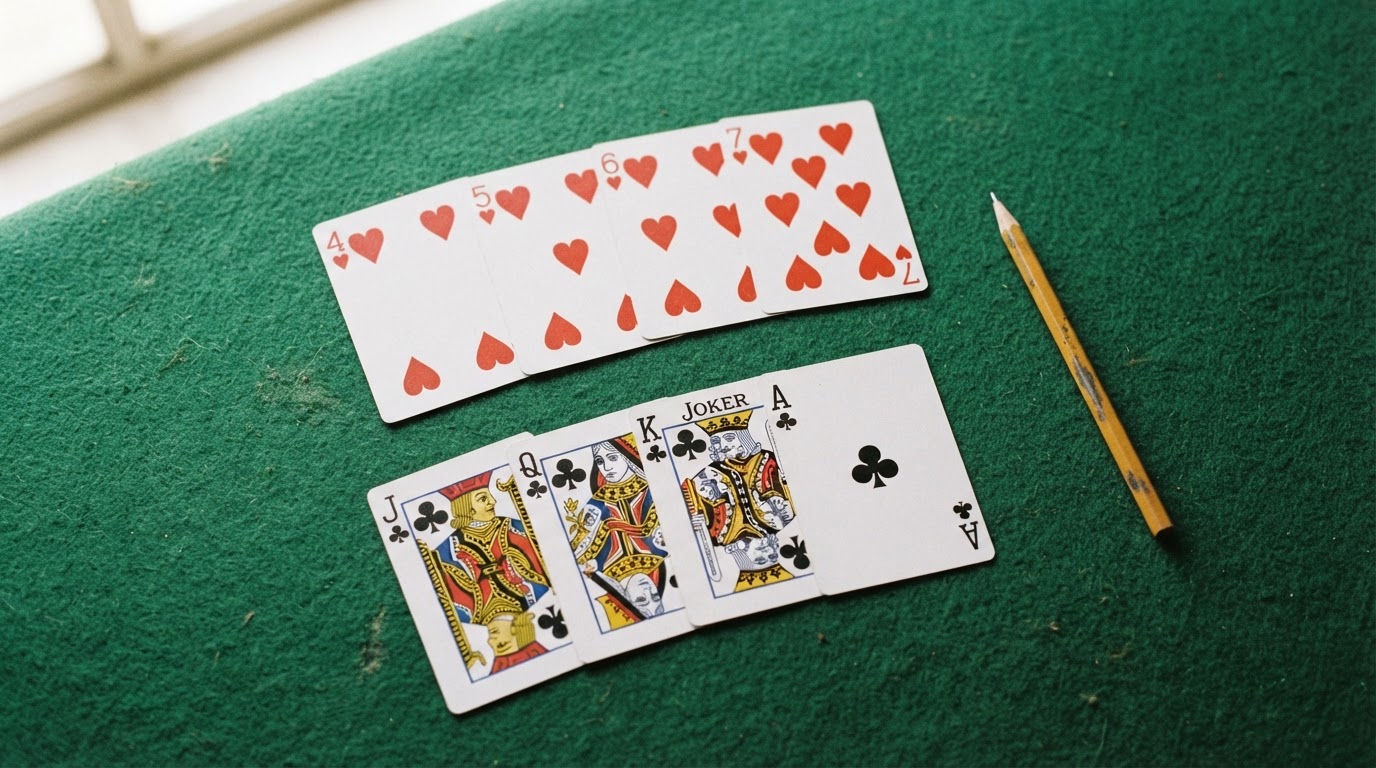
Short answer: A pure sequence contains at least three consecutive natural cards of one suit. A joker used in place of a missing card makes that sequence impure. In a standard 13-card hand, a pure sequence is essential, but the rest of the hand still needs a second sequence and valid groups. Rules for ace and wild-card treatment can vary by game, so verify the rule panel for your table.
Use this sequence test in order
First line up the suits. Then read the ranks without skipping a number. Finally mark any joker substitution. For example, 6♥ 7♥ 8♥ is pure; 6♥ 🃏 8♥ is impure because the joker supplies 7♥. A set such as 9♠ 9♥ 9♦ is a valid group in common rules, but it is never a sequence.
20 card groups, classified
| Cards | Result | Reason |
|---|---|---|
| 3♥ 4♥ 5♥ | Pure | Three natural consecutive hearts. |
| 10♣ J♣ Q♣ K♣ | Pure | Four consecutive clubs. |
| A♦ 2♦ 3♦ | Pure in common rules | Low-ace run; confirm variant. |
| Q♠ K♠ A♠ | Pure in common rules | High-ace run; confirm variant. |
| K♣ A♣ 2♣ | Invalid run | Ace does not wrap around. |
| 4♥ 5♣ 6♥ | Invalid run | Mixed suits. |
| 7♠ 8♠ 10♠ | Not a sequence | 9♠ is missing. |
| 8♦ 9♦ 🃏 | Impure | Joker fills 10♦. |
| 4♥ 🃏 6♥ | Impure | Joker fills 5♥. |
| 5♣ 6♣ 🃏 8♣ | Impure | Joker fills 7♣. |
| 5♣ 🃏 8♣ | Invalid with one joker | Two ranks are missing. |
| 9♠ 9♥ 9♦ | Set | Same rank, three suits. |
| J♣ J♦ J♥ | Set | Same rank, three suits. |
| 7♠ 7♠ 7♥ | Invalid set | The same physical card is duplicated. |
| 6♦ 7♦ 8♦ 9♦ | Pure | Four natural consecutive diamonds. |
| J♥ Q♥ K♥ A♥ | Pure in common rules | High ace at the end; confirm variant. |
| A♣ 2♣ 3♣ 4♣ | Pure in common rules | Low ace at the beginning. |
| 9♣ 10♣ J♦ | Invalid run | The suit changes at the jack. |
| 6♠ 7♠ 8♠ | Pure | Use the natural 7♠ even if 7 is the wild rank, where printed value counts. |
| 2♥ 3♥ 4♥ + 🃏 | Pure run plus separate joker | A spare joker is not automatically part of the run. |
Two complete 13-card audits
Hand A: valid under the common sequence test
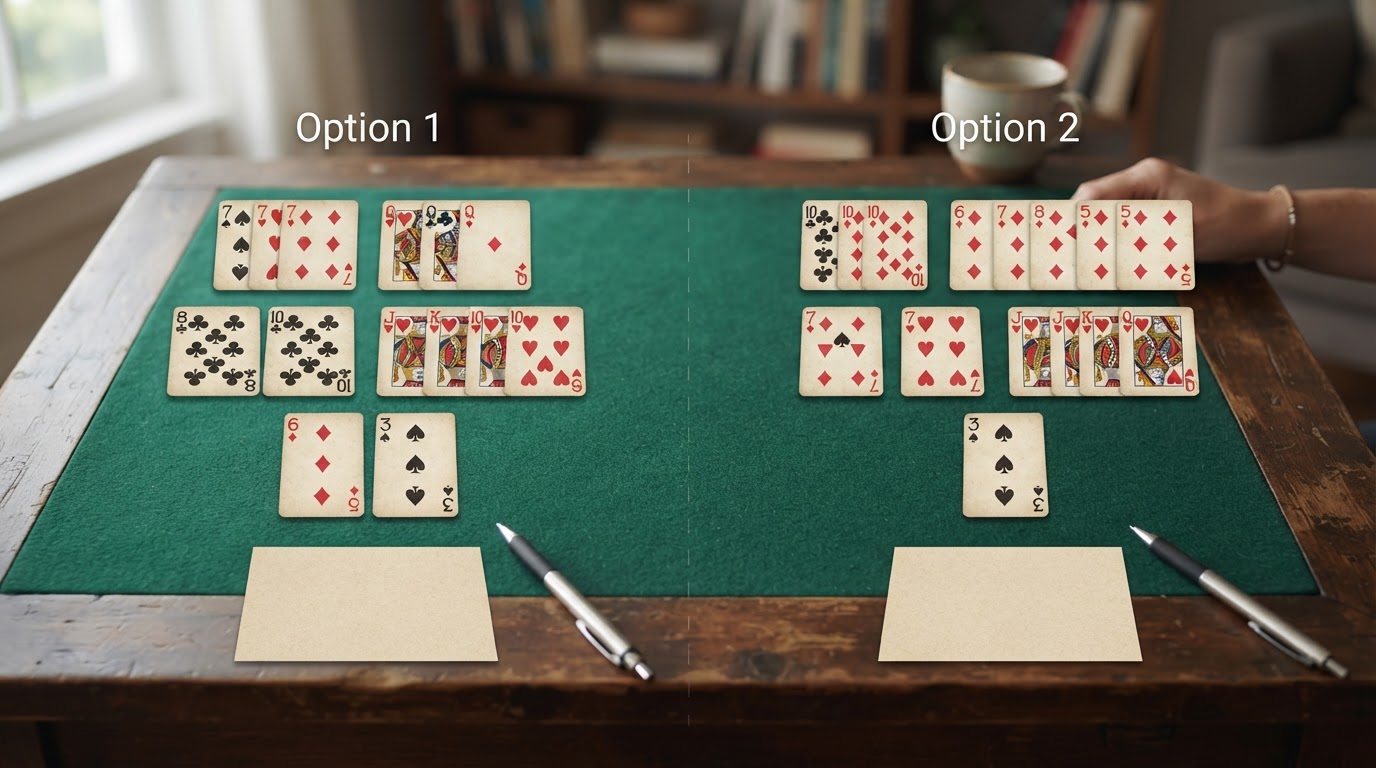
3♥ 4♥ 5♥ 6♥ | 9♣ 10♣ J♣ | K♦ K♠ K♥ | 7♠ 8♠ 9♠
Count: 4 + 3 + 3 + 3 = 13. The first, second and fourth groups are pure sequences. The kings are a set in three different suits. No card is reused. This hand therefore has the required pure run and a second sequence; check whether your particular table adds a separate four-card-run condition.
Hand B: every card looks grouped, but it fails
4♥ 5♥ 6♥ | 8♠ 8♥ 8♦ | J♣ J♥ J♦ | 2♠ 2♥ 2♦ 2♣
Count: 3 + 3 + 3 + 4 = 13. The first group is pure; the remaining groups are sets. There is no second sequence, so the usual declaration condition is not met. Neat grouping alone is not enough.
Joker and ace checks
A joker can fill one missing rank in an impure run, but it cannot make that run pure. A-2-3 and Q-K-A are accepted in many Indian rummy rules; K-A-2 is not a continuous sequence. Wild-card rules vary: some games treat the printed rank normally in a natural run, while other implementations explain a special condition. Follow the specific game’s rule text when it differs.
Practice: say why, not just what
- Q♥ K♥ A♥ — usually a pure high-ace run.
- K♦ A♦ 2♦ — not a wraparound run.
- 5♠ 🃏 7♠ — impure if the joker is 6♠.
- 10♣ J♣ Q♦ — invalid because suits change.
- 4♣ 5♣ 6♣ and 7♦ 8♦ 9♦ — two sequences; still audit every other card.
Continue learning
Practice with the free sequence trainer, then audit a full hand with the declaration detective. See the 13-card declaration checklist for a whole-hand walkthrough. These examples explain common rules; use the rule panel for the exact game you are playing.


Leave a Reply