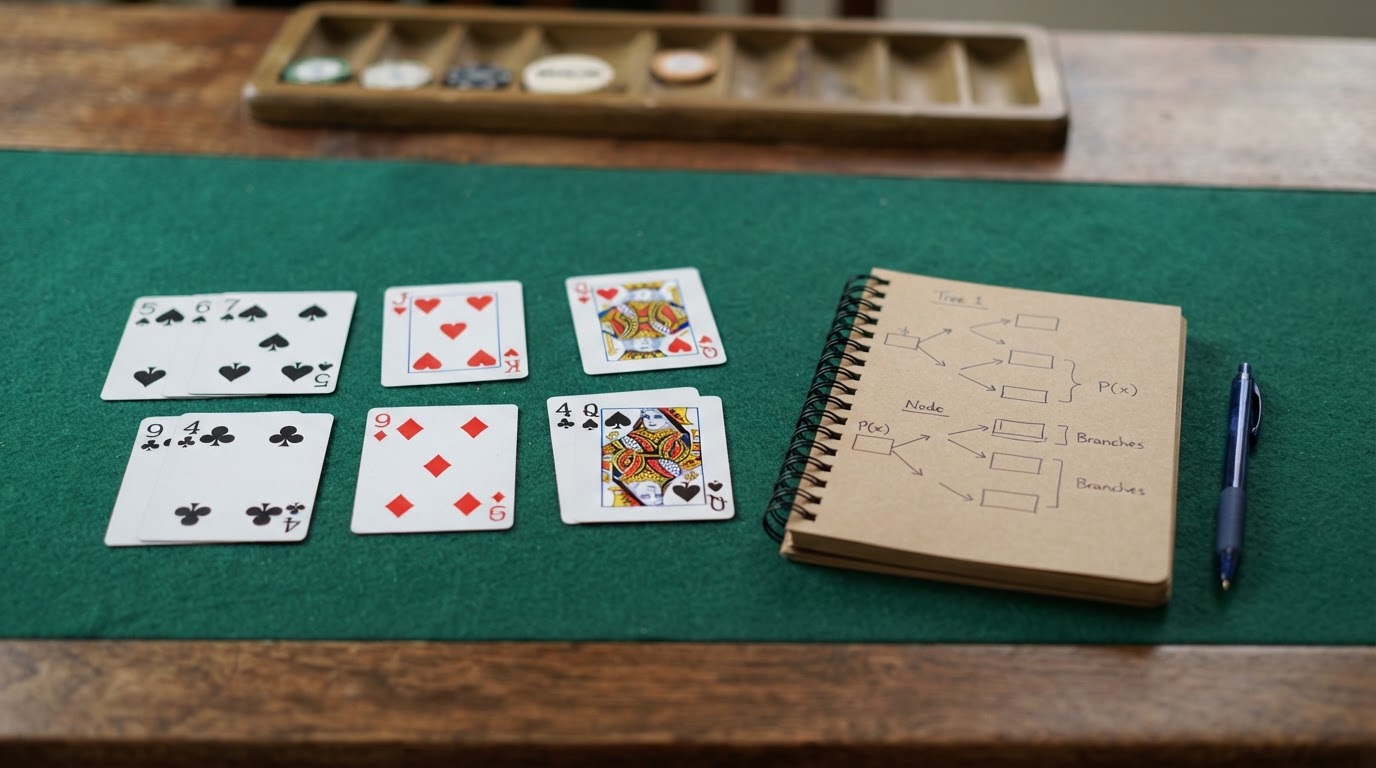
What does a rummy score measure? In common points-rummy formats, it is the value of cards left unmatched when an opponent makes a valid declaration. The score is not a measure of how many groups you made or how close the hand looked. Exact caps, drop scores and invalid-declaration penalties depend on the app or table rules.
Card values and the cap
Number cards usually carry their printed value; J, Q, K and A commonly count as 10 each. A joker used in a valid group typically carries no penalty, while an ungrouped joker is often treated as zero, but check the specific format. Many points games cap a losing hand at 80 points. That cap is a maximum, not a target score and not a rule for every rummy variant.
Worked hand: group first, count second
Suppose the hand is 4♥ 5♥ 6♥ | 8♣ 9♣ 10♣ | K♦ K♠ K♥ | A♠ 7♦ 3♣ 2♥. The three runs and the kings set account for nine cards; the four unmatched cards are A♠, 7♦, 3♣ and 2♥. Under the common values their raw total is 10+7+3+2=22. That is the starting point if the opponent declares and those four cards remain ungrouped. The hand itself is not a valid declaration because it has loose cards and only two sequences; the example is a losing-hand score, not a winning declaration.
Why grouping changes the arithmetic
If 2♥ 3♥ 4♥ can be formed from the loose cards and an available draw, those cards may move into a valid run; but do not count a card twice. A possible-looking run that mixes suits remains loose. Likewise, three same-rank cards with duplicate suits may fail as a set. Only valid groups reduce unmatched points.
When the 80-point cap applies
If the raw unmatched total is 94 in a format with an 80-point cap, the recorded loss may be 80. In a format without that cap, the result differs. Some games also use separate drop penalties, wrong-declaration penalties, or rules for a player who has not met the required sequence condition. Never transfer one app’s scoring table to another without checking.
Audit checklist
- Separate valid runs and sets from loose cards.
- Confirm suits, consecutive ranks and joker substitutions.
- Count each card once.
- Apply the published value for each loose card.
- Apply the cap or special penalty only if the game rules state it.
For group classification, use the worked sequence examples and sequence trainer. Scoring is format-specific; the in-game rules screen is authoritative.



Leave a Reply