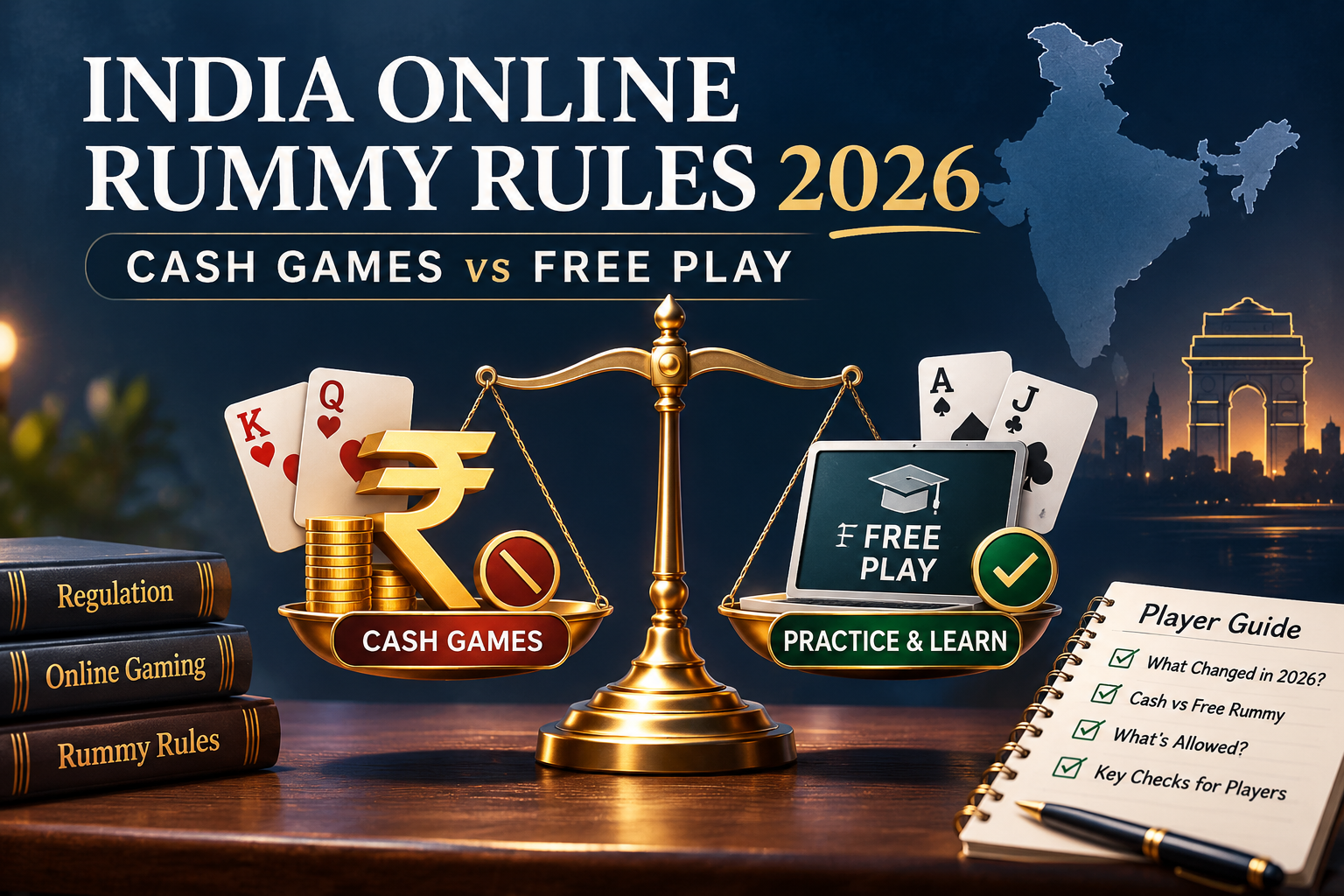
TL;DR — November 19, 2026: India’s Promotion and Regulation of Online Gaming Act, 2025 and implementing Rules, 2026 took effect on May 1, 2026. The framework prohibits online money games regardless of whether their outcome depends on skill or chance. Free, non-staking recreational and educational games are conceptually different, but their actual classification depends on their mechanics, payments, prizes and regulatory determinations. This guide explains the difference for Rummy players, not a blanket approval of any website.
Last reviewed: November 19, 2026. Editorial research by Rummy.land. This is general educational information, not legal advice, legal certification, or a claim of regulatory approval. For a product-specific legal determination, consult qualified Indian counsel and the competent authority.
What Actually Changed in 2026?
India enacted the Promotion and Regulation of Online Gaming Act (Act No. 32 of 2025) in August 2025. Importantly, enactment and commencement were not the same event. The central government issued a commencement notification on April 22, 2026, appointing May 1, 2026 as the date the Act would take effect. MeitY announced final Promotion and Regulation of Online Gaming Rules, 2026 on April 22, also effective May 1. These are final 2026 rules, not the 2025 consultation draft.
| Date | Event | Why it matters |
|---|---|---|
| August 22, 2025 | Presidential assent and Gazette publication of Act No. 32 of 2025 | Created the statutory framework, subject to commencement notification |
| October 2025 | Draft rules circulated for feedback | Draft text should not be confused with binding final rules |
| April 22, 2026 | Final rules and commencement notification published | Confirmed operative framework and effective date |
| May 1, 2026 | Act and 2026 rules took effect | Online money-game prohibitions and regulatory mechanisms became operative |
| September 18, 2026 | Press report on MeitY RTI response | Reported no games registered as of September 1; a dated snapshot, not proof of present registration status |
Cash Rummy vs Free Rummy: The Key Legal Distinction
Section 2(1)(g) of the Act defines an online money game by the user paying fees, depositing money or other stakes with an expectation of winning monetary or other enrichment in return. The definition expressly covers games based on skill, chance, or both, with a separate statutory treatment of qualifying e-sports. Section 2(1)(i) defines online social games around the absence of staking and expected monetary gain, while allowing certain genuine access or subscription charges that are not wagers.
| Example model | Player pays or stakes? | Potential return | How to assess |
|---|---|---|---|
| Cash-entry Rummy tournament | Yes, to compete for winnings | Cash or monetary reward | High-risk money-game characteristics; skill does not create a general exemption |
| Free Rummy practice hand | No | No cash or redeemable prize | Closer to a social or educational game; assess full service design |
| Paid tutorial subscription | Fixed access fee, not tied to outcome | Learning access only | The Act contemplates non-wager access fees for social games; classification still depends on facts |
| Virtual coins bought with money and redeemable for value | Yes or economically equivalent | Convertible or monetisable benefit | Potential ‘other stakes’ and money-game concerns |
| Free points and badges with no cash-out | No monetary stake | Non-redeemable achievement | Different risk profile, but check whether hidden incentives change the economics |
| Tournament described as ‘skill only’ with paid stakes | Yes | Financial winnings | Skill label alone does not remove the statutory money-game issue |
Why the Old ‘Rummy Is a Skill Game’ Answer Is Not Enough
Before this national framework, many debates centred on whether Rummy was a game of skill rather than chance under different state laws. That distinction remains important historically and in other legal contexts. But the 2025 Act’s online-money-game definition expressly says irrespective of whether the game is based on skill, chance, or both. Therefore, claiming ‘Rummy involves skill’ does not, by itself, answer whether a paid-stakes online service falls within the 2026 prohibition. Nor does the law make every digital card lesson an online money game.
Read the Statute: Five Clauses That Matter
| Provision | Plain-English significance |
|---|---|
| Section 2(1)(g) | Defines an online money game; looks at payments or stakes and expected enrichment |
| Section 2(1)(i) | Defines online social games; distinguishes recreation and skill development from wagering |
| Section 2(1)(j) | Defines ‘other stakes’, including some credits, coins, tokens or objects with money-equivalent or convertible character |
| Section 5 | Prohibits offering and facilitating online money games/services |
| Sections 6–7 | Restrict promotion of online money games and fund transfers for money-gaming services |
What About Virtual Coins, Tokens and ‘Free’ Entry?
A ‘free’ label does not settle classification. Ask whether players must buy coins to participate, whether coins can be sold, exchanged or redeemed, whether a purchase unlocks a chance of monetary gain, and whether a third party provides value linked to winning. Section 2(1)(j) is deliberately broader than banknotes. Conversely, ordinary non-redeemable scores used only for learning are not automatically equivalent to cash stakes. These are analytical examples, not formal rulings on a specific product.
Six scenarios worth checking
- Scenario A: A free 13-card hand arranger with no deposits, prizes or cash-out: principally educational functionality.
- Scenario B: A cash-entry table paying winners: core money-game indicators.
- Scenario C: An entry fee solely for accessing video lessons, unrelated to winning: potentially different from a stake; inspect actual terms.
- Scenario D: Purchased coins redeemable for gift cards: investigate money-equivalent value and return expectation.
- Scenario E: ‘Free’ tournament whose winnings are paid by a sponsor: do not assume permissibility; the exact model and applicable classification matter.
- Scenario F: A game advertised offshore but offered to Indian users: the Act expressly addresses services operated outside India as well as domestic services.
Does India Ban Every Form of Online Rummy?
No: the legislation distinguishes online money games from online social games and e-sports. However, it would also be misleading to say that every free Rummy website is officially approved. Classification can turn on the mechanics of the whole service, and registration or determination rules may apply. A game’s availability online, a payment provider’s acceptance, or a site’s own marketing copy is not proof of regulatory authorisation.
What the 2026 Rules Add Beyond the Ban
MeitY’s April 22 announcement describes a classification and registration framework under the Online Gaming Authority of India, along with user safety, transparency and grievance-redressal procedures. The announced safety features include age checks, time controls, parental controls, user reporting and fair-play monitoring, appropriate to the relevant risk profile. The rules also provide an appeal route for users dissatisfied with a provider’s grievance response. Requirements are not necessarily identical for every service; read the applicable rules and any later notifications.
Registration: What We Know and What We Do Not
A September 18, 2026 news report, citing MeitY information supplied to the Central Information Commission, said that no online game had received registration as of September 1, 2026, and that 201 complaints had been received. This is a dated report about an earlier snapshot. It does not establish whether any game is registered as of this article’s November 19 update. Readers should check current official authority records and notifications rather than treating a September figure as live status.
A Practical Checklist for Indian Rummy Players
- Money: Does entry require deposits, fees that function as stakes, or purchases tied to winning?
- Rewards: Can points, coins, tokens or objects be redeemed or exchanged for real-world value?
- Marketing: Does the service promise financial returns, or present itself as a learning game?
- Rules: Are entry conditions, fees, prize terms and withdrawal policies transparent?
- Safety: Are age protections, reporting and grievance contacts clearly available where applicable?
- Verification: Is any claimed registration supported by a current official record rather than a screenshot or banner?
- Privacy: Does the product request sensitive identity or payment information that is unnecessary for practice?
- Changes: Have the service terms or official regulations changed since the last time you checked?
Free Rummy Learning Without Cash Stakes
Players who simply want to understand Indian Rummy can practise without wagering. Rummy.land provides educational tools including the 13-Card Sequence Trainer, Joker Challenge, Declaration Detective, Hand Solver and Points Calculator. These are learning aids, not a claim that the site or any tool has obtained a government determination. Some tools use simplified rules; always verify against the format you play.
A Decision Framework: Seven Questions Before Calling a Game ‘Free’
The most important distinction is economic substance, not the word printed on a button. Use the following seven-question audit as an educational screening method. It is not a government classification test and cannot replace the Authority’s determination.
| Question | Lower-risk illustration | Warning sign |
|---|---|---|
| 1. Must a player pay to enter? | No payment or deposit | Entry money or stake |
| 2. Can a player win value? | Non-transferable score | Cash, vouchers or transferable rewards |
| 3. Are virtual credits sold? | Free practice credits only | Purchased tokens used for prizes |
| 4. Can credits be redeemed? | No conversion or resale | Withdrawal, marketplace or gift cards |
| 5. Is a subscription a wager? | Fixed lesson access independent of results | Payment tied to prize eligibility |
| 6. Does a third party pay winners? | No prize pool | Sponsor-funded valuable winnings: needs review |
| 7. What does the platform promise? | Learning and entertainment | Earn money by playing |
Three Worked Case Studies: Why Similar Apps Can Be Different
Case Study 1: A 13-Card Sequence Trainer
Hypothetical product: A visitor is dealt sample cards and chooses which cards make a pure sequence. There is no account, purchase, deposit, reward, withdrawal or token market. The product teaches a card rule. Under the statutory distinction, the absence of stakes and expected monetary winnings is a central fact supporting an educational/social-game analysis. What this does not prove: that any named service has received an official classification or is exempt from all other laws.
Case Study 2: A Paid ‘Skill Tournament’
Hypothetical product: A platform charges ₹100 to join a Rummy table and pays cash to top finishers. Its marketing says the game is ‘100% skill’. That claim does not resolve the 2025 Act’s definition: paid stakes plus expected financial gain are the crucial facts, and the Act expressly refers to skill and chance alike. Renaming the entry fee a ‘service charge’ does not automatically change its function.
Case Study 3: A Free App With Purchased Coins
Hypothetical product: An app offers free starter coins, sells additional coins and allows winners to exchange their balance for vouchers. It may feel free to first-time users, but purchases and convertible rewards create economic questions under the ‘other stakes’ definition. The specific transferability, exchange mechanics, terms and regulatory interpretation matter; the correct answer is not simply ‘free’ or ‘banned’ without examining them.
What to Check in a Platform’s Terms: An Evidence Worksheet
| Document or screen | Exact detail to record | Why it matters |
|---|---|---|
| Entry and pricing page | All payments required to play or compete | Distinguishes access fees from stakes |
| Rewards policy | Cash, voucher, crypto or non-cash prize terms | Tests expected enrichment |
| Coin and wallet terms | Purchase, transfer, refund and cash-out options | Tests money-equivalent mechanics |
| Promotional claims | Screenshots of earning promises | Reveals advertised economic purpose |
| Grievance page | Provider contact, escalation and response process | Helps assess user protections |
| Registration claim | Official authority record and certificate number, if applicable | Avoids reliance on unverified badges |
| Last-updated date | Date of the rules and terms you read | Prevents reliance on outdated policies |
Registration and Player Complaints: A Practical Route
The government’s April 30 explanatory note states that registration is required for notified categories and that the digital certificate may be valid for up to ten years. It also describes a two-tier grievance system: a user dissatisfied with a provider’s response may approach the Authority within 30 days, with an additional appeal to the Appellate Authority. These details matter because a claim of ‘government registration’ should be checked against the correct category and current official records, not inferred from a website logo.
If you have a dispute, keep screenshots of the game terms, payments and messages; use the provider’s published grievance process first; and consult the government’s explanation of the appeal mechanism. This is general process information, not advice about the merits of any claim.
What We Can Verify, and What We Cannot
| Statement | Evidence level | Limit |
|---|---|---|
| The 2026 Rules came into force May 1 | Official PIB / MeitY announcement | Confirmed effective date |
| The Act covers money games based on skill or chance | Primary statutory text | Specific products still need factual classification |
| Registration applies to notified categories | Official government explanatory note | Not every game automatically requires identical registration |
| No game was registered as of September 1 | Secondary report citing an RTI response | Historical snapshot; not November status |
| Rummy.land is an approved social game | Not established | This article makes no such claim |
Research Notes, Corrections and Trust Signals
Source hierarchy: Primary law (India Code / Gazette) comes first; MeitY and PIB explanations provide implementation context; a news report is used only for its dated account of registration information. Method: We compare definitions with clearly labelled hypothetical examples, not legal opinions about real competitors. Limitations: We have not independently verified every provider’s classification, registration or current enforcement status. Corrections: Readers should check original government notices and report substantive errors through the website’s contact channel. Update trigger: New Gazette notifications, official determinations, court decisions and changes to the registration framework warrant a new review.
Further official reading: Act No. 32 of 2025 · PIB announcement, April 22, 2026 · PIB explanatory note, April 30, 2026.
Frequently Asked Questions
Is cash Rummy legal in India in November 2026?
The national Act prohibits online money games and related services, regardless of whether the underlying game is skill-based or chance-based. Whether a particular product meets the statutory definition is a fact-specific question. Consult current official guidance and legal counsel for an individual service.
Are free Rummy games banned?
The Act separately recognises online social games, including recreation and skill-development activities without money stakes or expected monetary winnings. That is not a blanket legal certificate for all products labelled ‘free’.
Does a ‘skill game’ label make a cash Rummy app exempt?
No. Section 2(1)(g) explicitly covers skill, chance and mixed games in its online-money-game definition. Qualifying e-sports have separate statutory conditions; merely calling Rummy an e-sport does not establish those conditions.
Can a free Rummy game sell a subscription?
The social-game definition contemplates a genuine subscription or one-time access fee that is not a wager or stake. A paid subscription tied to winning, redeemable tokens or prize eligibility requires closer analysis.
Are virtual coins always harmless?
No. The Act’s ‘other stakes’ definition addresses money-equivalent or convertible items, including certain coins and tokens. Look at purchase, transfer and redemption mechanics.
Can I trust a site claiming ‘government-approved Rummy’?
Ask for the current official registration or determination record and confirm it with the competent authority. A site’s claim alone is not verification.
Does the Act cover offshore websites?
The Act states that it applies to online money-gaming services offered within India or operated from outside India. Offshore hosting is not a simple exemption.
What changed on May 1, 2026?
The 2025 Act and final 2026 implementing Rules commenced, activating the national framework and the procedures announced by MeitY.
Where can I learn Rummy rules without betting?
Start with Rummy.land’s free learning tools, then read the 30-example guide to pure and impure sequences.
Sources and Editorial Verification
We prioritised primary Indian government materials for statutory definitions and effective dates. We distinguish official documents from a secondary report about September registration data. This article is not a substitute for the statute, rules, subsequent notifications or a qualified legal opinion.
- India Code — Promotion and Regulation of Online Gaming Act, 2025 (official text)
- MeitY — Act, final 2026 Rules and Gazette notifications
- Press Information Bureau, April 22, 2026 — official explanation of final Rules
- The New Indian Express, September 18, 2026 — dated RTI-based registration report
Editorial update policy: Review this page when MeitY or the Online Gaming Authority publishes new classifications, registration notices, amendments or relevant judicial developments. Date-specific observations should never be presented as current without rechecking.



Leave a Reply