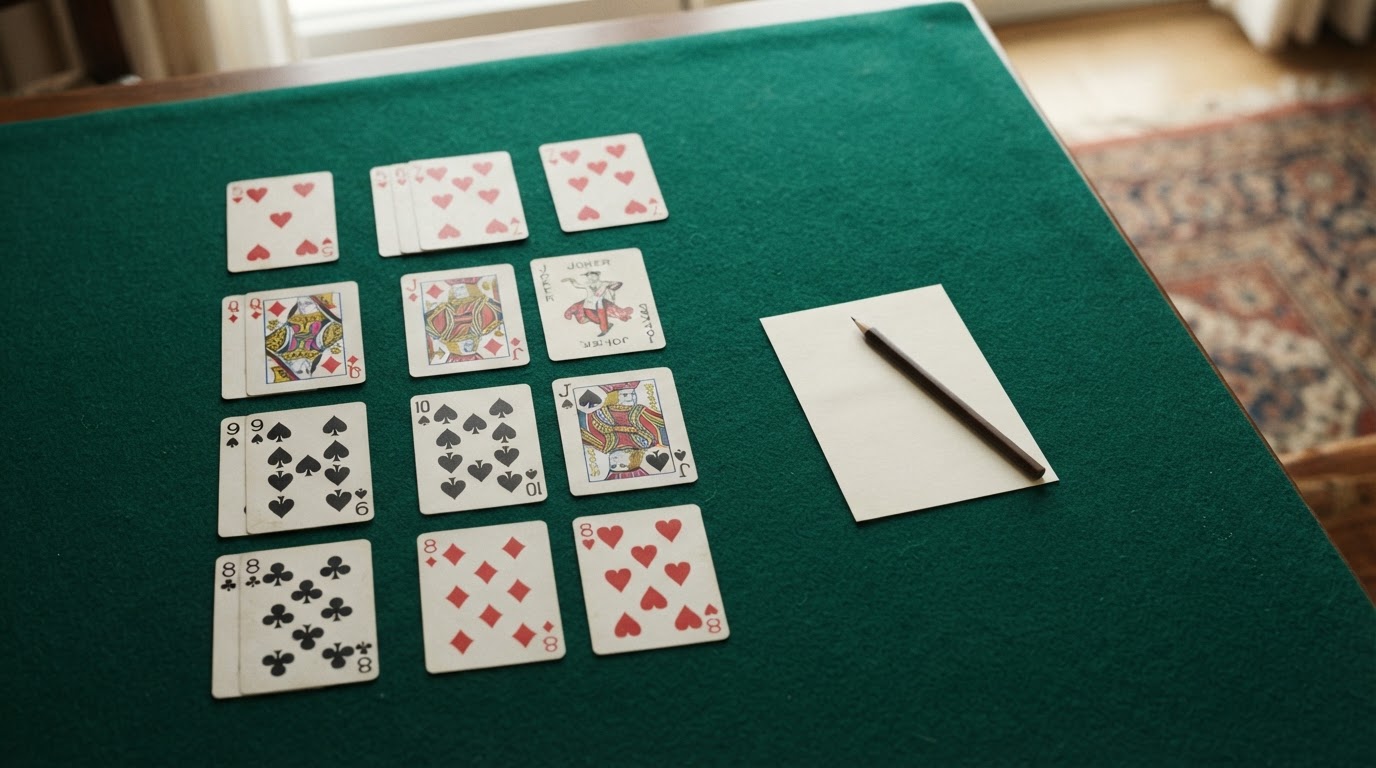
Quick answer: A valid 13-card Indian rummy declaration generally needs at least two sequences, including one pure sequence, with every remaining card arranged in valid sequences or sets. A hand can have 13 cards in tidy-looking groups and still be invalid. This guide shows how to test a hand, not merely memorise a rule.
The 60-second declaration audit
- Count exactly 13 cards and ensure no card appears in two groups.
- Identify a run of at least three consecutive cards in the same suit that does not use a joker as a substitute: your pure sequence.
- Identify a second valid sequence. It may be pure or impure.
- Validate every remaining group as a sequence or a set.
- Check your particular game’s additional conditions, especially any minimum four-card sequence requirement.
What counts as a sequence or a set?
| Cards | Classification | Why |
|---|---|---|
| 4♥ 5♥ 6♥ | Pure sequence | Natural consecutive cards, one suit |
| 8♣ 🃏 10♣ | Impure sequence | Joker replaces 9♣ |
| J♠ J♥ J♦ | Set | Same rank, different suits |
| 4♥ 5♣ 6♥ | Invalid sequence | Mixed suits |
| K♠ A♠ 2♠ | Invalid sequence | Ace cannot wrap from high to low |
| 7♠ 7♠ 7♥ | Invalid ordinary set | Duplicate suit in one set |
Four complete 13-card hands, tested
Hand A: a valid hand with a four-card pure run
3♥ 4♥ 5♥ 6♥ | 9♣ 10♣ J♣ | K♦ K♠ K♥ | 7♠ 8♠ 9♠
Count: 4+3+3+3=13. The first, second and fourth groups are pure sequences; the third is a set of kings in different suits. This example also meets a four-card-sequence condition if your game’s version requires one.
Hand B: every card grouped, but no second sequence
4♥ 5♥ 6♥ | 8♠ 8♥ 8♦ | J♣ J♥ J♦ | 2♠ 2♥ 2♦ 2♣
Count: 3+3+3+4=13. The first group is a pure sequence; the other three are sets. The second sequence is missing. That is why tidy grouping alone does not make a declaration valid.
Hand C: a joker used correctly
3♠ 4♠ 5♠ | 8♥ 9♥ 🃏 | J♣ J♦ J♥ | 6♦ 7♦ 8♦ 9♦
Count: 3+3+3+4=13. The joker replaces 10♥, making the second group an impure sequence. The first and last groups are pure sequences; the jacks form a set. The joker does not remove the need for a pure sequence.
Hand D: two good runs cannot rescue a bad group
4♥ 5♥ 6♥ | 8♠ 9♥ 10♠ | J♣ J♥ J♦ | 2♣ 3♣ 4♣ 5♣
Count: 3+3+3+4=13. The first and last groups are pure runs. But 8♠ 9♥ 10♠ is neither a valid run nor a set. Every group must pass its own test.
Five mistakes that lead to a false declaration
- Counting sets as sequences. Three sevens make a set, not a run.
- Calling a joker-assisted run pure. 4♥ 🃏 6♥ uses a substitute, so it is impure.
- Ignoring suits. Consecutive numbers are not enough when suits differ.
- Wrapping the ace. A-2-3 and Q-K-A can be valid, but K-A-2 is not a continuous run.
- Ignoring variant-specific conditions. Some games additionally require a four-card run; check the rules of the exact game.
Practice: can you explain the answer?
Q1: Is A♦ 2♦ 3♦ pure? Q2: Is 7♠ 7♥ 7♦ a sequence? Q3: In 6♣ 🃏 8♣, which card is missing? Q4: Can 4♥ 🃏 7♥ be completed with one joker? Q5: If a hand has one pure run and three valid sets, is it a valid declaration?
Answers: Q1 Yes, under standard ace-low sequence rules. Q2 No, it is a set. Q3 7♣. Q4 No, both 5♥ and 6♥ are missing. Q5 No, it lacks a second sequence.
Use the free learning tools
Try the Declaration Detective to identify invalid groups, then check a complete arrangement with the Hand Solver. For joker-specific questions, use the Joker Challenge. These are educational tools, not real-money games.
Rules and editorial scope
See the published 13-card rummy rules and Octro’s variant explanation. They illustrate why the precise platform rules matter. All hands above were constructed for teaching and are not claimed to be real match records. This article does not promote money-stake play.


Leave a Reply